Ch. 11 - Parametric Equations and Polar Coordinates
Hass - Thomas' Calculus 15th Edition
Hass15th EditionThomas' CalculusISBN: 9780137616077Not the one you use?Change textbook
Chapter 11, Problem 11.PE.66

Graphing Conic Sections


Exercises 63-68 give equations for conic sections and tell how many units up or down and to the right or left each curve is to be shifted. Find an equation for the new conic section, and find the new foci, vertices, centers, and asymptotes, as appropriate. If the curve is a parabola, find the new directrix as well.


x²/169 + y²/144 = 1, right 5, up 12

Verified step by step guidance
1
Identify the type of conic section given by the equation \(\frac{x^{2}}{169} + \frac{y^{2}}{144} = 1\). Since both \(x^{2}\) and \(y^{2}\) terms are positive and the equation equals 1, this is an ellipse centered at the origin \((0,0)\).
Recall the standard form of an ellipse centered at \((h,k)\): \(\frac{(x - h)^{2}}{a^{2}} + \frac{(y - k)^{2}}{b^{2}} = 1\). Here, \(a^{2} = 169\) and \(b^{2} = 144\), so \(a = 13\) and \(b = 12\).
Apply the given shifts: right 5 units and up 12 units. This changes the center from \((0,0)\) to \((5,12)\). Substitute \(h=5\) and \(k=12\) into the ellipse equation to get the new equation: \(\frac{(x - 5)^{2}}{169} + \frac{(y - 12)^{2}}{144} = 1\).
Find the new foci. For an ellipse, the focal distance \(c\) is given by \(c = \sqrt{a^{2} - b^{2}}\). Calculate \(c\) and then determine the coordinates of the foci relative to the new center \((5,12)\). Since \(a^{2} > b^{2}\), the major axis is along the x-axis, so the foci are at \((h \pm c, k)\).
Find the vertices. The vertices lie along the major axis at a distance \(a\) from the center. So, the vertices are at \((h \pm a, k)\). Since this is an ellipse, there are no asymptotes or directrix to find.

Verified video answer for a similar problem:

This video solution was recommended by our tutors as helpful for the problem above.
Video duration:
3m
Was this helpful?

Key Concepts

Here are the essential concepts you must grasp in order to answer the question correctly.

Conic Sections and Their Standard Equations

Conic sections are curves obtained by intersecting a plane with a double-napped cone, including ellipses, parabolas, hyperbolas, and circles. Each has a standard equation form, such as the ellipse equation x²/a² + y²/b² = 1, where a and b determine the shape and size. Understanding these forms is essential for identifying the type of conic and its geometric properties.
Recommended video:
5:33
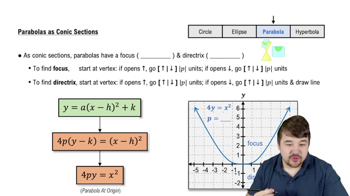
Parabolas as Conic Sections

Translation of Conic Sections

Translating a conic involves shifting its graph horizontally and/or vertically without changing its shape. This is done by replacing x with (x - h) and y with (y - k) in the equation, where h and k are the horizontal and vertical shifts, respectively. Translation affects the location of key features like centers, vertices, and foci.
Recommended video:
5:33
Parabolas as Conic Sections

Finding Key Features of Conics After Translation

Key features such as foci, vertices, centers, asymptotes, and directrices define the shape and position of conics. After translation, these points shift by the same amounts as the graph. Calculating their new coordinates requires adding the translation values to the original coordinates, ensuring an accurate description of the transformed conic.
Recommended video:
3:08
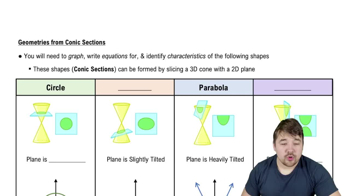
Geometries from Conic Sections