Ch. 3 - Derivatives
Briggs - Calculus: Early Transcendentals 3rd Edition
Briggs3rd EditionCalculus: Early TranscendentalsISBN: 9780136847243Not the one you use?Change textbook
Chapter 3, Problem 3.9.51

49–55. Derivatives of tower functions (or g^h) Find the derivative of each function and evaluate the derivative at the given value of a.
h (x) = x^√x; a = 4

Verified step by step guidance
1
Identify the function h(x) = x^√x. This is a tower function where the base and the exponent are both functions of x.
Rewrite the function using logarithms to simplify differentiation: h(x) = e^(√x * ln(x)). This transformation uses the property that a^b = e^(b * ln(a)).
Differentiate the transformed function using the chain rule. Let u(x) = √x * ln(x), then h(x) = e^u(x). The derivative of h(x) is h'(x) = e^u(x) * u'(x).
Find the derivative of u(x) = √x * ln(x) using the product rule: u'(x) = (1/(2√x)) * ln(x) + (√x/x).
Evaluate the derivative h'(x) at x = 4 by substituting x = 4 into the expression for h'(x) obtained in the previous steps.

Verified video answer for a similar problem:

This video solution was recommended by our tutors as helpful for the problem above.
Video duration:
9m
Was this helpful?

Key Concepts

Here are the essential concepts you must grasp in order to answer the question correctly.

Derivatives

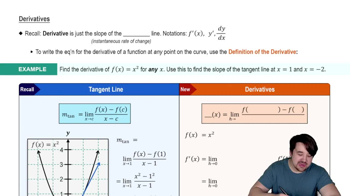
A derivative represents the rate of change of a function with respect to its variable. It is a fundamental concept in calculus that allows us to determine the slope of the tangent line to the curve of a function at any given point. The derivative can be computed using various rules, such as the power rule, product rule, and chain rule, depending on the form of the function.
Recommended video:
05:44
Derivatives

Tower Functions

Tower functions, such as g^h, involve exponentiation where the base and the exponent can be functions themselves. In the case of h(x) = x^√x, the function is defined as x raised to the power of the square root of x. Understanding how to differentiate these types of functions requires applying the chain rule and recognizing the structure of the function as a composition of simpler functions.
Recommended video:
06:21
Properties of Functions

Evaluating Derivatives

Evaluating a derivative at a specific point involves substituting the value of the variable into the derivative function after it has been computed. This process provides the instantaneous rate of change of the original function at that particular point. In this case, evaluating the derivative of h(x) at a = 4 will yield the slope of the tangent line to the curve at that point.
Recommended video:
5:14
Evaluate Logarithms