
Angle to a particle (part 2) The figure in Exercise 81 shows the particle traveling away from the sensor, which may have influenced your solution (we expect you used the inverse sine function). Suppose instead that the particle approaches the sensor (see figure). How would this change the solution? Explain the differences in the two answers. <IMAGE>
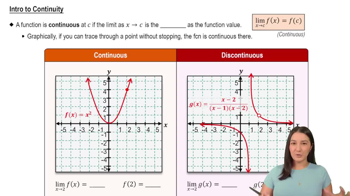
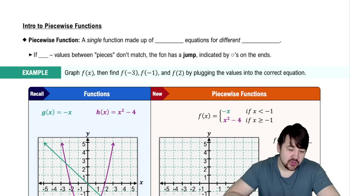
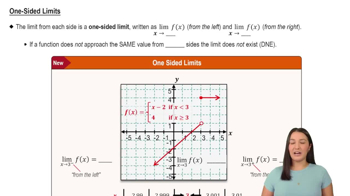
Continuity of a piecewise function Let g(x) = <matrix 2x1> For what values of a is g continuous?
Verified step by step guidance
Verified video answer for a similar problem:
Key Concepts
Continuity
Piecewise Function
Limit
49–55. Derivatives of tower functions (or g^h) Find the derivative of each function and evaluate the derivative at the given value of a.
h (x) = x^√x; a = 4
Consider the curve x=e^y. Use implicit differentiation to verify that dy/dx = e^-y and then find d²y/dx² .
75–86. Logarithmic differentiation Use logarithmic differentiation to evaluate f'(x).
f(x) = tan¹⁰x / (5x+3)⁶
Orthogonal trajectories Two curves are orthogonal to each other if their tangent lines are perpendicular at each point of intersection (recall that two lines are perpendicular to each other if their slopes are negative reciprocals). A family of curves forms orthogonal trajectories with another family of curves if each curve in one family is orthogonal to each curve in the other family. For example, the parabolas y = cx² form orthogonal trajectories with the family of ellipses x²+2y² = k, where c and k are constants (see figure).
Find dy/dx for each equation of the following pairs. Use the derivatives to explain why the families of curves form orthogonal trajectories. <IMAGE>
y = cx²; x²+2y² = k, where c and k are constants
Calculate the derivative of the following functions. In some cases, it is useful to use the properties of logarithms to simplify the functions before computing f'(x).
y = 4 log₃(x²−1)
