
Ch. 9 - Differential Equations
Briggs - Calculus: Early Transcendentals 3rd Edition
Briggs3rd EditionCalculus: Early TranscendentalsISBN: 9780136847243Not the one you use?Change textbook
Chapter 9, Problem 9.2.29b

29–32. {Use of Tech} Errors in Euler’s method Consider the following initial value problems.


b. Using the exact solution given, compute the errors in the Euler approximations at t=0.2 and t=0.4.


y′(t) = −y, y(0) = 1; y(t) = e⁻ᵗ

Verified step by step guidance
1
Identify the given initial value problem (IVP): \(y'(t) = -y\), with initial condition \(y(0) = 1\), and the exact solution \(y(t) = e^{-t}\).
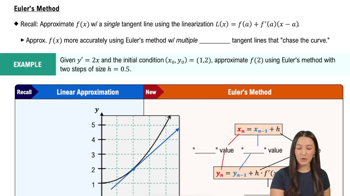
Recall that Euler's method approximates the solution using the formula: \(y_{n+1} = y_n + h f(t_n, y_n)\), where \(h\) is the step size and \(f(t, y) = y'(t)\).
Choose the step size \(h\) based on the points where the approximation is needed. Since we want approximations at \(t=0.2\) and \(t=0.4\), a natural choice is \(h=0.2\).
Compute the Euler approximations step-by-step: starting from \(t_0=0\), \(y_0=1\), calculate \(y_1\) at \(t_1=0.2\) and then \(y_2\) at \(t_2=0.4\) using the Euler update formula.
Calculate the exact values at \(t=0.2\) and \(t=0.4\) using \(y(t) = e^{-t}\), then find the errors by subtracting the Euler approximations from the exact values: \(\text{Error} = |y_{exact} - y_{Euler}|\) at each point.

Verified video answer for a similar problem:

This video solution was recommended by our tutors as helpful for the problem above.
Video duration:
5m
Was this helpful?

Key Concepts

Here are the essential concepts you must grasp in order to answer the question correctly.

Euler's Method

Euler's method is a numerical technique to approximate solutions of initial value problems for differential equations. It uses a stepwise approach, estimating the next value by moving along the slope given by the differential equation at the current point. This method is simple but can accumulate errors depending on the step size.
Recommended video:
07:33
Euler's Method

Exact Solution of Differential Equations

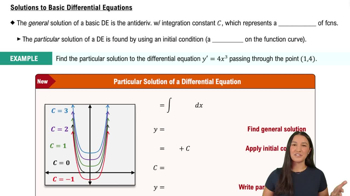
The exact solution is the precise function that satisfies the differential equation and initial conditions. In this problem, y(t) = e⁻ᵗ is the exact solution, which allows comparison with numerical approximations to evaluate their accuracy. Knowing the exact solution helps quantify the error in numerical methods.
Recommended video:
04:00
Solutions to Basic Differential Equations

Error Analysis in Numerical Methods

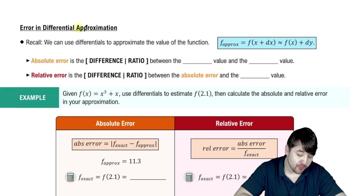
Error analysis involves calculating the difference between the exact solution and the numerical approximation at specific points. It helps assess the accuracy and reliability of methods like Euler's. Errors depend on factors like step size and the nature of the differential equation.
Recommended video:
04:57
Determining Error and Relative Error
Related Practice
Textbook Question

42–43. Implicit solutions for separable equations For the following separable equations, carry out the indicated analysis.

b. Find the value of the arbitrary constant associated with each initial condition. (Each initial condition requires a different constant.)


y'(t) = t²/(y² + 1); y(−1) = 1, y(0) = 0, y(−1) = −1

1
views
Textbook Question

Blowup in finite time Consider the initial value problem y'(t) = yⁿ + 1, y(0) = y₀, where n is a positive integer.

b. Solve the initial value problem with n = 2 and y₀ = 1/√2.

1
views
Textbook Question

38–43. Equilibrium solutions A differential equation of the form y′(t)=f(y) is said to be autonomous (the function f depends only on y). The constant function y=y0 is an equilibrium solution of the equation provided f(y0)=0 (because then y'(t)=0 and the solution remains constant for all t). Note that equilibrium solutions correspond to horizontal lines in the direction field. Note also that for autonomous equations, the direction field is independent of t. Carry out the following analysis on the given equations.

b. Sketch the direction field, for t≥0.


y′(t) = 2y + 4

Textbook Question

38–43. Equilibrium solutions A differential equation of the form y′(t)=f(y) is said to be autonomous (the function f depends only on y). The constant function y=y0 is an equilibrium solution of the equation provided f(y0)=0 (because then y'(t)=0 and the solution remains constant for all t). Note that equilibrium solutions correspond to horizontal lines in the direction field. Note also that for autonomous equations, the direction field is independent of t. Carry out the following analysis on the given equations.

b. Sketch the direction field, for t≥0. 


y′(t) = 6 - 2y

1
views
Textbook Question

52-56. In this section, several models are presented and the solution of the associated differential equation is given. Later in the chapter, we present methods for solving these differential equations.


{Use of Tech} Drug infusion The delivery of a drug (such as an antibiotic) through an intravenous line may be modeled by the differential equation m'(t) + km(t) = I, where m(t) is the mass of the drug in the blood at time t ≥ 0, k is a constant that describes the rate at which the drug is absorbed, and I is the infusion rate.


b. Graph the solution for I = 10 mg/hr and k = 0.05 hr⁻¹.

Textbook Question

{Use of Tech} Chemical rate equations Let y(t) be t he concentration of a substance in a chemical reaction (typical units are moles/liter). The change in the concentration, under appropriate conditions, is modeled by the equation dy/dt=-ky^n for t≥0, where k>0 is a rate constant and the positive integer n is the order of the reaction.

b. Solve the initial value problem for a second-order reaction (n=2) assuming y(0)=y0.

1
views