 Back
BackBusiness Calculus: Functions, Exponents, and Logarithms – Mini-Textbook Study Notes
Study Guide - Smart Notes
 Tailored notes based on your materials, expanded with key definitions, examples, and context.
Functions and Their Graphs
Relations and Functions
Understanding the distinction between relations and functions is foundational in business calculus. A relation is any set of ordered pairs (x, y), representing a connection between input and output values. A function is a special type of relation in which each input (x) is associated with at most one output (y).
Relation: Any pairing of x and y values; can have multiple outputs for a single input.
Function: Each input has at most one output; passes the Vertical Line Test.
Vertical Line Test: If any vertical line crosses the graph more than once, the graph is not a function.
Example: The set {(−3, 5), (0, 2), (3, 5)} is a function because each x-value is paired with only one y-value.
Domain and Range
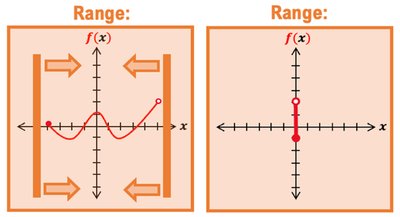
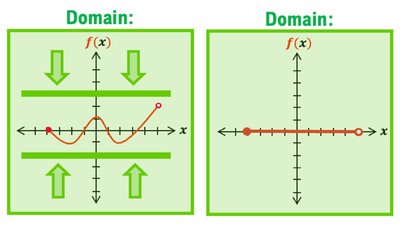
The domain of a function is the set of all possible input values (x-values), while the range is the set of all possible output values (y-values). To determine these from a graph:
Domain: Project the graph onto the x-axis; the interval covered is the domain.
Range: Project the graph onto the y-axis; the interval covered is the range.
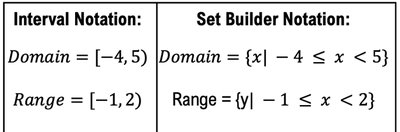
Interval Notation: Uses brackets [ ] for inclusive endpoints and parentheses ( ) for exclusive endpoints.
Set Builder Notation: Describes the set using inequalities, e.g., {x | -4 ≤ x < 5}.
Union Symbol ( ∪ ): Used when the domain or range consists of multiple intervals.
Piecewise Functions
Definition and Evaluation
A piecewise function is defined by different equations over different intervals of the domain. These functions may have jumps or discontinuities where the pieces do not connect smoothly.
Notation:
Evaluating: To find , determine which piece applies for and substitute.
Example: For as above, (since ), (since ).
Properties of Functions
Key Properties
Functions can be classified and analyzed by their graphical properties:
Maximum/Minimum: The highest/lowest point on the graph.
Increasing/Decreasing: Intervals where the function rises or falls as x increases.
Constant: Intervals where the function remains unchanged.
Symmetry: Even functions are symmetric about the y-axis (); odd functions are symmetric about the origin ().
Graphs of Common Functions
Basic Function Types
Constant Function: ; domain: all real numbers, range: {c}.
Identity Function: ; domain and range: all real numbers.
Square Function: ; domain: all real numbers, range: .
Cube Function: ; domain and range: all real numbers.
Square Root Function: ; domain: , range: $[0, \infty)$.
Cube Root Function: ; domain and range: all real numbers.
Transformations of Functions
Types of Transformations
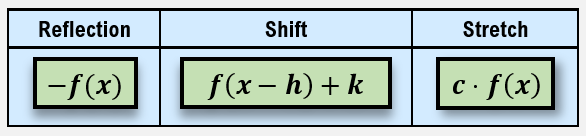
Transformations alter the position or shape of a function's graph. The main types are:
Reflection: Flips the graph over an axis, e.g., reflects over the x-axis.
Shift (Translation): Moves the graph horizontally and/or vertically, e.g., shifts right by h and up by k.
Stretch/Compression: Multiplies the function by a constant, e.g., stretches (if ) or compresses (if ) the graph.
Operations with Functions
Adding, Subtracting, Multiplying, and Dividing Functions
Functions can be combined using arithmetic operations. The domain of the resulting function is the intersection of the domains of the original functions (and, for division, where the denominator is not zero).
Addition:
Subtraction:
Multiplication:
Division: ,
Rules of Exponents
Exponent Properties
Exponent rules are essential for simplifying algebraic expressions:
Product Rule:
Quotient Rule:
Zero Exponent: (for )
Negative Exponent:
Power Rule:
Power of a Product:
Power of a Quotient:
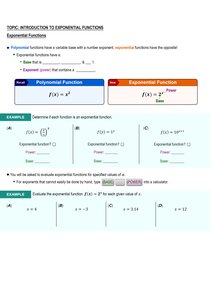
Exponential Functions
Definition and Properties
An exponential function has the form , where the base is a positive real number not equal to 1. Exponential functions model rapid growth or decay and are fundamental in business applications such as compound interest and population growth.
Domain: All real numbers
Range: for
Example:
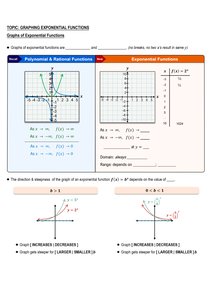
Graphs of Exponential Functions
The graph of increases rapidly for and decreases for . The y-intercept is always at (0, 1), and the x-axis () is a horizontal asymptote.
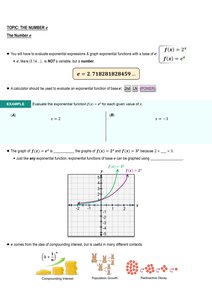
The Number e
The constant is the base of the natural exponential function . It arises in continuous growth and decay models, such as continuously compounded interest.
Logarithmic Functions
Introduction to Logarithms
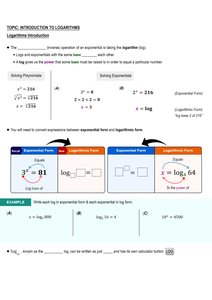
A logarithm is the inverse of an exponential function. The logarithm answers the question: "To what power must be raised to get ?"
Exponential Form:
Logarithmic Form:
Graphs of Logarithmic Functions
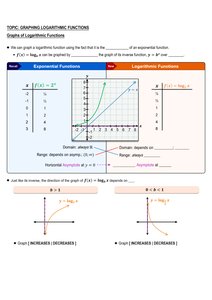
The graph of is the reflection of across the line . The domain is , and the range is all real numbers. The y-axis () is a vertical asymptote.
Properties of Logarithms
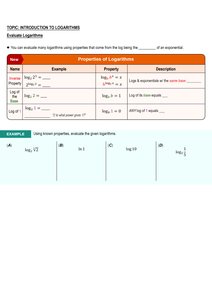
Logarithms have several important properties that simplify calculations:
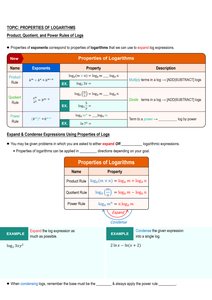
Product Rule:
Quotient Rule:
Power Rule:
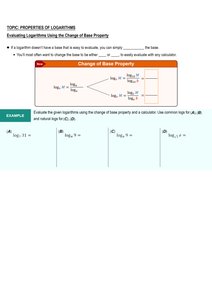
Change of Base:
Solving Exponential and Logarithmic Equations
To solve equations involving exponentials or logarithms:
Exponential Equations: Rewrite both sides with the same base if possible, then set exponents equal.
Logarithmic Equations: Use properties of logarithms to combine terms, then rewrite in exponential form to solve for the variable.
Change of Base: Use when the equation cannot be rewritten with the same base.
Summary Table: Function Transformations
Transformation | Formula | Description |
|---|---|---|
Reflection | Reflects over x-axis | |
Shift | Shifts right by h, up by k | |
Stretch | Stretches vertically by c |
Summary Table: Exponent Rules
Rule | Formula | Description |
|---|---|---|
Product | Add exponents | |
Quotient | Subtract exponents | |
Zero Exponent | Any nonzero base to zero power is 1 | |
Negative Exponent | Reciprocal of positive exponent | |
Power Rule | Multiply exponents | |
Power of Product | Distribute exponent | |
Power of Quotient | Distribute exponent |
