Single strands of nucleic acids are directional, meaning that there are two different ends. What functional groups define the two different ends of a strand?
Ch.4 - Nucleic Acids and the RNA World
Chapter 4, Problem 1
What are the four nitrogenous bases found in RNA?
a. Cytosine, guanine, thymine, uracil (C, G, T, U)
b. Adenine, cytosine, guanine, thymine (A, C, G, T)
c. Adenine, cytosine, guanine, uracil (A, C, G, U)
d. Alanine, cysteine, glycine, threonine (A, C, G, T)
Verified step by step guidance1
Understand that RNA is a nucleic acid similar to DNA, but it has a different set of nitrogenous bases.
Recall that DNA contains the bases adenine (A), cytosine (C), guanine (G), and thymine (T).
Note that RNA replaces thymine (T) with uracil (U), so RNA contains adenine (A), cytosine (C), guanine (G), and uracil (U).
Review the options provided in the problem to identify which set of bases corresponds to RNA.
Select the option that lists adenine, cytosine, guanine, and uracil (A, C, G, U) as the nitrogenous bases found in RNA.

Verified video answer for a similar problem:
This video solution was recommended by our tutors as helpful for the problem above.
Video duration:
59sWas this helpful?
Key Concepts
Here are the essential concepts you must grasp in order to answer the question correctly.
Nitrogenous Bases in RNA
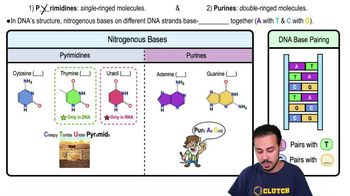
RNA contains four nitrogenous bases: adenine (A), cytosine (C), guanine (G), and uracil (U). These bases pair with complementary bases during RNA synthesis, with adenine pairing with uracil and cytosine pairing with guanine. Unlike DNA, RNA does not contain thymine.
Recommended video:
Guided course
5 Nitrogenous Bases
Difference Between DNA and RNA Bases
The primary difference between DNA and RNA bases is the presence of uracil in RNA instead of thymine, which is found in DNA. This substitution is crucial for RNA's function and structure, as uracil forms hydrogen bonds with adenine during transcription and translation processes.
Recommended video:
Guided course
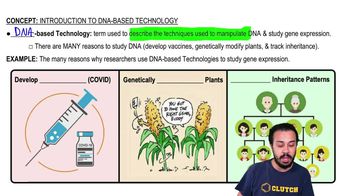
Introduction to DNA-Based Technology
Role of Nitrogenous Bases in Genetic Coding
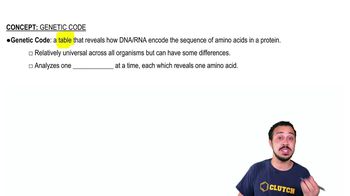
Nitrogenous bases are fundamental to genetic coding, as they form sequences that encode genetic information. In RNA, these sequences are transcribed from DNA and translated into proteins, with each triplet of bases (codon) specifying an amino acid, thus playing a critical role in protein synthesis.
Recommended video:
Guided course
Genetic Code
Related Practice
Textbook Question
3
views
Textbook Question
What determines the primary structure of a DNA molecule?
a. Stem-and-loop configuration
b. Complementary base pairing
c. Deoxyribonucleotide sequence
d. Hydrophobic interactions and hydrogen bonding
5
views
Textbook Question
Evaluate the following statements related to the synthesis of nucleic acids. Select True or False for each statement.
T/F Ribonucleotides are added to the 3′ end of a DNA strand.
T/F Polymerization of nucleic acids occurs by the formation of phosphodiester bonds.
T/F Complementary pairing between sugars is required for copying nucleic acids.
T/F Strands in a double helix are synthesized in an antiparallel orientation.
3
views