Single strands of nucleic acids are directional, meaning that there are two different ends. What functional groups define the two different ends of a strand?
Ch.4 - Nucleic Acids and the RNA World
Chapter 4, Problem 3
Evaluate the following statements related to the synthesis of nucleic acids. Select True or False for each statement.
T/F Ribonucleotides are added to the 3′ end of a DNA strand.
T/F Polymerization of nucleic acids occurs by the formation of phosphodiester bonds.
T/F Complementary pairing between sugars is required for copying nucleic acids.
T/F Strands in a double helix are synthesized in an antiparallel orientation.
Verified step by step guidance1
Understand the structure of nucleic acids: DNA and RNA are composed of nucleotides, which include a sugar, a phosphate group, and a nitrogenous base. DNA has deoxyribonucleotides, while RNA has ribonucleotides.
Evaluate the statement about ribonucleotides: Ribonucleotides are not added to the 3′ end of a DNA strand during DNA synthesis. Instead, deoxyribonucleotides are added to the 3′ end of a growing DNA strand. RNA synthesis involves adding ribonucleotides to the 3′ end of an RNA strand.
Consider the polymerization process: Polymerization of nucleic acids involves the formation of phosphodiester bonds between the phosphate group of one nucleotide and the hydroxyl group on the sugar of another nucleotide. This is a key mechanism in both DNA and RNA synthesis.
Analyze the statement about complementary pairing: Complementary pairing occurs between nitrogenous bases, not sugars. In DNA, adenine pairs with thymine, and cytosine pairs with guanine. In RNA, adenine pairs with uracil.
Examine the orientation of strands in a double helix: DNA strands in a double helix are synthesized in an antiparallel orientation, meaning one strand runs 5′ to 3′ and the other runs 3′ to 5′. This orientation is crucial for the replication and function of DNA.

Verified video answer for a similar problem:
This video solution was recommended by our tutors as helpful for the problem above.
Video duration:
3mWas this helpful?
Key Concepts
Here are the essential concepts you must grasp in order to answer the question correctly.
Nucleic Acid Synthesis
Nucleic acid synthesis involves the formation of DNA and RNA strands through the addition of nucleotides. In DNA synthesis, deoxyribonucleotides are added to the 3′ end of the growing strand, while RNA synthesis involves ribonucleotides. This process is crucial for replication and transcription, ensuring genetic information is accurately copied and expressed.
Recommended video:
Guided course
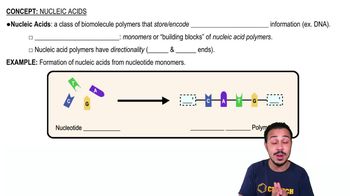
Nucleic Acids
Phosphodiester Bonds
Phosphodiester bonds are the chemical linkages that connect nucleotides in a nucleic acid strand. These bonds form between the phosphate group of one nucleotide and the hydroxyl group on the sugar of another, creating a backbone for DNA and RNA. The formation of phosphodiester bonds is essential for the polymerization of nucleic acids, allowing for the stable and continuous structure of genetic material.
Recommended video:
Guided course
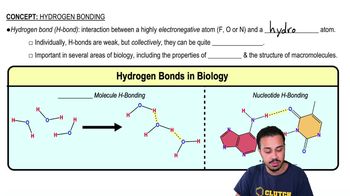
Hydrogen Bonding
Antiparallel Orientation
In a double helix, DNA strands are oriented in an antiparallel fashion, meaning one strand runs in the 5′ to 3′ direction while the other runs 3′ to 5′. This orientation is critical for the complementary base pairing that stabilizes the double helix structure. Antiparallel synthesis ensures that each strand can serve as a template for replication, maintaining the integrity of genetic information.
Recommended video:
Guided course
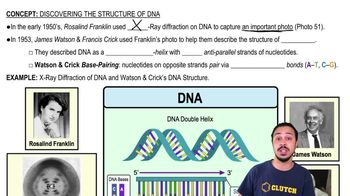
Discovering the Structure of DNA
Related Practice
Textbook Question
3
views
Textbook Question
What determines the primary structure of a DNA molecule?
a. Stem-and-loop configuration
b. Complementary base pairing
c. Deoxyribonucleotide sequence
d. Hydrophobic interactions and hydrogen bonding
5
views
Textbook Question
If nucleotides from the DNA of a human were quantified and 30 percent of them contained the base adenine, what percentage of them would contain the base guanine?
a. 20 percent
b. 30 percent
c. 40 percent
d. 70 percent
1
views
Textbook Question
What is responsible for the increased stability of DNA compared to RNA?
2
views
Textbook Question
What are the four nitrogenous bases found in RNA?
a. Cytosine, guanine, thymine, uracil (C, G, T, U)
b. Adenine, cytosine, guanine, thymine (A, C, G, T)
c. Adenine, cytosine, guanine, uracil (A, C, G, U)
d. Alanine, cysteine, glycine, threonine (A, C, G, T)
2
views