Back

Titrations of Amino Acids with Non-Ionizable R-Groups quiz

Control buttons has been changed to "navigation" mode.
1/15
  • What are the two ionizable groups present in amino acids with non-ionizable R groups?

    The two ionizable groups are the alpha amino group and the alpha carboxyl group.
  • How many pKa values do amino acids with non-ionizable R groups have, and what do they correspond to?

    They have two pKa values: one for the alpha amino group and one for the alpha carboxyl group.
  • What does the inflection point (midpoint) on a titration curve represent?

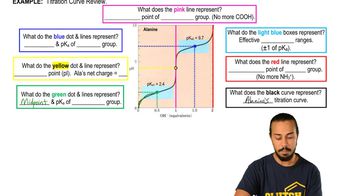
    The inflection point represents the pKa value, where half of the acid has been neutralized.
  • What is the equivalence point on a titration curve?

    The equivalence point is where 100% of an acid has been neutralized.
  • How is the isoelectric point (pI) of an amino acid with a non-ionizable R group calculated?

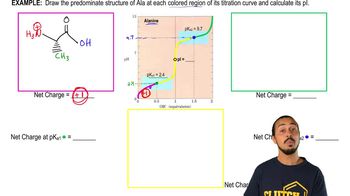
    The pI is the average of the two pKa values of the amino and carboxyl groups.
  • At what point on the titration curve does the amino acid have a net charge of zero?

    At the isoelectric point (pI), the amino acid has a net charge of zero.
  • What is the predominant structure of alanine at low pH (below both pKa values)?

    Both the amino and carboxyl groups are protonated, giving alanine a net charge of +1.
  • What is the net charge of alanine at a pH equal to the pKa of the carboxyl group?

    The net charge is +0.5 because the amino group is fully protonated (+1) and the carboxyl group is half deprotonated (-0.5).
  • What is the predominant structure of alanine at a pH between the two pKa values (near the pI)?

    The amino group is protonated (NH3+) and the carboxyl group is deprotonated (COO-), resulting in a net charge of 0.
  • What is the net charge of alanine at a pH equal to the pKa of the amino group?

    The net charge is -0.5 because the carboxyl group is fully deprotonated (-1) and the amino group is half protonated (+0.5).
  • What is the predominant structure of alanine at high pH (above both pKa values)?

    Both the amino and carboxyl groups are deprotonated, giving alanine a net charge of -1.
  • What is the effective buffering range for each ionizable group in an amino acid?

    The effective buffering range is within plus or minus one pH unit of each pKa value.
  • How many inflection points and equivalence points are present in the titration curve of an amino acid with a non-ionizable R group?

    There are two inflection points and two equivalence points, one for each ionizable group.
  • What happens to the net charge of an amino acid as the pH increases across the titration curve?

    The net charge becomes more negative as the pH increases.
  • What is the isoelectric point (pI) of alanine if its pKa values are 2.4 and 9.7?

    The pI is (2.4 + 9.7) / 2 = 6.05.