Back

Titrations of Amino Acids with Non-Ionizable R-Groups definitions

Control buttons has been changed to "navigation" mode.
1/15
  • Amino Acid

    Organic molecule with both an alpha amino and alpha carboxyl group, forming the backbone of proteins.
  • Non-Ionizable R Group

    Side chain in an amino acid that does not participate in acid-base reactions during titration.
  • Polyprotic Acid

    Compound containing multiple acidic hydrogens, each with its own pKa value.
  • Alpha Amino Group

    Functional group attached to the central carbon of an amino acid, typically with a pKa near 9–10.5.
  • Alpha Carboxyl Group

    Functional group attached to the central carbon of an amino acid, typically with a pKa near 2.
  • Titration Curve

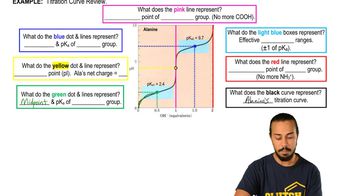
    Graph showing pH changes as titrant is added, revealing inflection and equivalence points for ionizable groups.
  • Inflection Point

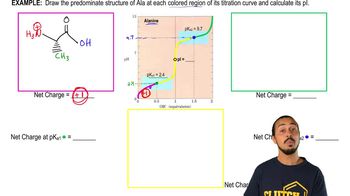
    Location on a titration curve where the curve changes direction, corresponding to a pKa value.
  • Equivalence Point

    Position on a titration curve where an ionizable group is fully neutralized by titrant.
  • Isoelectric Point

    pH at which the net charge of an amino acid is zero, calculated as the average of two pKa values.
  • Buffering Range

    pH interval within one unit above or below a pKa where an amino acid resists changes in pH.
  • Conjugate Acid

    Form of an ionizable group with an extra proton, predominating at pH below its pKa.
  • Conjugate Base

    Form of an ionizable group lacking a proton, predominating at pH above its pKa.
  • Net Charge

    Sum of charges on all ionizable groups of an amino acid at a given pH, shifting from positive to negative as pH increases.
  • Alanine

    Amino acid with a methyl side chain, used as a model for titration curves of non-ionizable R group amino acids.
  • Molar Equivalent

    Amount of titrant required to neutralize one mole of an ionizable group during titration.