Back

Summary of Membrane Transport quiz

Control buttons has been changed to "navigation" mode.
1/15
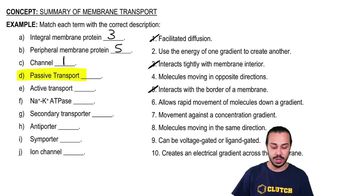
  • What is the main difference between passive and active transport across membranes?

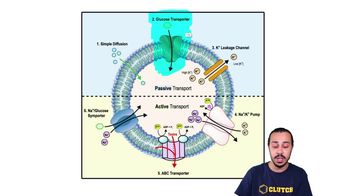
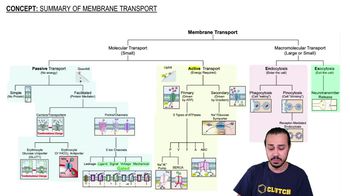
    Passive transport does not require energy and moves molecules down their concentration gradient, while active transport requires energy to move molecules against their gradient.
  • How does simple diffusion differ from facilitated diffusion?

    Simple diffusion does not require a protein mediator, while facilitated diffusion requires a protein such as a carrier, transporter, or channel.
  • What role do carriers and transporters play in facilitated diffusion?

    Carriers and transporters undergo a conformational change to move molecules across the membrane down their concentration gradient.
  • How do channels and pores facilitate membrane transport?

    Channels and pores create a tunnel through the membrane, allowing molecules to diffuse down their concentration gradient without a conformational change.
  • What is an example of a carrier-mediated facilitated diffusion in erythrocytes?

    The GLUT1 transporter allows erythrocytes to uptake glucose from the blood by facilitated diffusion.
  • What is the function of the erythrocyte chloride-bicarbonate antiporter?

    It enables the chloride shift, helping transport carbon dioxide from tissues to the lungs.
  • What distinguishes a leakage ion channel from gated ion channels?

    Leakage ion channels are always open, while gated ion channels open and close in response to specific stimuli.
  • Name the four types of gated ion channels and their stimuli.

    Ligand-gated (extracellular ligands), signal-gated (intracellular signals), voltage-gated (membrane potential changes), and mechanically-gated (mechanical stimuli like touch or pressure).
  • What is primary active transport and what energy source does it use?

    Primary active transport directly uses ATP hydrolysis to move molecules against their concentration gradient.
  • List two examples of P-type ATPases discussed in the lesson.

    The sodium-potassium pump and the SERCA (calcium ion) pump are examples of P-type ATPases.
  • How does secondary active transport differ from primary active transport?

    Secondary active transport uses the energy from an ion gradient, which is established by ATP hydrolysis, to move another molecule against its gradient.
  • What is the function of the sodium-glucose symporter?

    It transports sodium down its gradient and glucose against its gradient into the cell, using the sodium gradient for energy.
  • What are the two main types of macromolecular transport?

    Endocytosis (molecules enter the cell) and exocytosis (molecules exit the cell).
  • Describe the three types of endocytosis.

    Phagocytosis (cell eating of solids), pinocytosis (cell drinking of liquids), and receptor-mediated endocytosis (uses receptor proteins).
  • How is exocytosis involved in neurotransmitter release?

    Exocytosis releases neurotransmitters from cells using snare fusion proteins to mediate vesicle fusion with the membrane.