Back

Stereochemistry of Monosaccharides quiz

Control buttons has been changed to "navigation" mode.
1/15
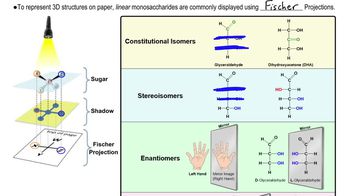
  • What is the purpose of using Fischer projections in monosaccharide stereochemistry?

    Fischer projections are used to represent the 3D structures of linear monosaccharides on paper, with horizontal bonds indicating groups projecting out of the page.
  • How do constitutional isomers differ from each other?

    Constitutional isomers differ in the connectivity of their atoms, even though they have the same chemical formula.
  • What distinguishes stereoisomers from constitutional isomers?

    Stereoisomers have the same atom connectivity but differ in their 3D spatial arrangement, while constitutional isomers differ in connectivity.
  • What are enantiomers in the context of monosaccharides?

    Enantiomers are stereoisomers that are non-superimposable mirror images of each other, like D- and L-glyceraldehyde.
  • How are diastereomers different from enantiomers?

    Diastereomers are stereoisomers that are not mirror images of each other, unlike enantiomers.
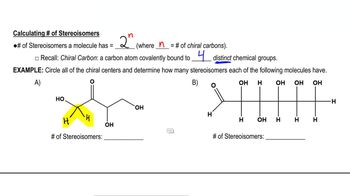
  • What is the formula to calculate the number of stereoisomers for a molecule?

    The number of stereoisomers is calculated as 2^n, where n is the number of chiral carbons in the molecule.
  • What defines a chiral carbon in a monosaccharide?

    A chiral carbon is a carbon atom covalently bonded to four distinct chemical groups.
  • If a monosaccharide has 4 chiral carbons, how many stereoisomers are possible?

    There are 16 possible stereoisomers, calculated as 2^4.
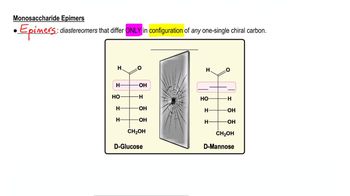
  • What is an epimer in monosaccharide chemistry?

    An epimer is a specific type of diastereomer that differs from another molecule only in the configuration of one chiral carbon.
  • How do D-glucose and D-mannose relate as epimers?

    D-glucose and D-mannose differ only in the configuration at the C2 chiral carbon, making them epimers.
  • Are epimers mirror images of each other?

    No, epimers are not mirror images; they are diastereomers that differ at only one chiral center.
  • What are the two main categories of isomers in monosaccharides?

    The two main categories are constitutional isomers and stereoisomers.
  • How can stereoisomers be further classified?

    Stereoisomers can be classified as enantiomers (mirror images) or diastereomers (not mirror images).
  • What is a classic example of constitutional isomers among monosaccharides?

    Glyceraldehyde and dihydroxyacetone are classic examples, as they have the same formula but different atom connectivity.
  • What is the key structural feature that makes two monosaccharides diastereomers?

    Diastereomers differ in the configuration at one or more (but not all) chiral carbons and are not mirror images of each other.