Back

Second Law of Thermodynamics quiz

Control buttons has been changed to "navigation" mode.
1/15
  • What does the second law of thermodynamics state about energy conversion efficiency?

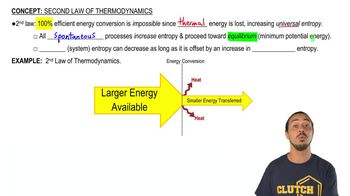
    It states that 100% efficient energy conversion is impossible because some energy is always lost as heat, increasing universal entropy.
  • How does the second law of thermodynamics relate to entropy?

    It states that all spontaneous processes increase universal entropy as they proceed toward equilibrium.
  • What happens to the energy that is not transferred during energy conversion?

    The energy that is not transferred is lost as heat, which increases the universal entropy.
  • What is a spontaneous process in thermodynamics?

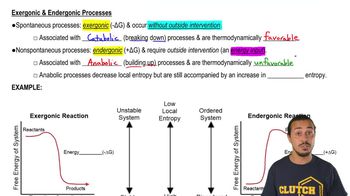
    A spontaneous process occurs without external energy input, has a negative delta G, and increases entropy.
  • Does a spontaneous process always occur quickly?

    No, spontaneous does not mean fast; some spontaneous processes can occur very slowly.
  • What type of biological processes are associated with spontaneous reactions?

    Catabolic processes, which break down larger molecules into smaller ones, are associated with spontaneous reactions.
  • What is a non-spontaneous process?

    A non-spontaneous process requires external energy input, has a positive delta G, and decreases local entropy.
  • Which type of biological processes are associated with non-spontaneous reactions?

    Anabolic processes, which build larger molecules from smaller ones, are associated with non-spontaneous reactions.
  • How do exergonic reactions affect the system's energy and entropy?

    Exergonic reactions release energy, lower the system's energy, and increase entropy, making them thermodynamically favorable.
  • What is the delta G value for exergonic reactions?

    Exergonic reactions have a negative delta G value.
  • How do endergonic reactions affect the system's energy and entropy?

    Endergonic reactions absorb energy, increase the system's energy, and decrease local entropy, making the system more ordered.
  • What is the delta G value for endergonic reactions?

    Endergonic reactions have a positive delta G value.
  • Can local entropy decrease in a system according to the second law of thermodynamics?

    Yes, local entropy can decrease as long as it is offset by a greater increase in universal entropy.
  • Do both exergonic and endergonic processes increase universal entropy?

    Yes, both types of processes ultimately contribute to an increase in universal entropy.
  • What is the relationship between stability and energy in exergonic and endergonic reactions?

    Exergonic reactions move toward a more stable, lower-energy, and more disordered state, while endergonic reactions create a less stable, higher-energy, and more ordered state.