Back

Second Law of Thermodynamics definitions

Control buttons has been changed to "navigation" mode.
1/15
  • Second Law of Thermodynamics

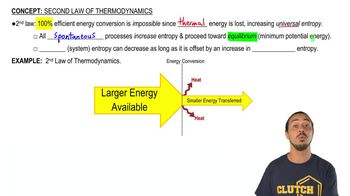
    Principle stating that energy conversions are never fully efficient, always resulting in increased universal disorder.
  • Entropy

    Measure of disorder or randomness in a system, which increases with every energy transfer.
  • Universal Entropy

    Total disorder in the universe, always rising as energy is lost as heat during processes.
  • Local Entropy

    Disorder within a specific system, which can decrease if offset by a greater increase elsewhere.
  • Spontaneous Process

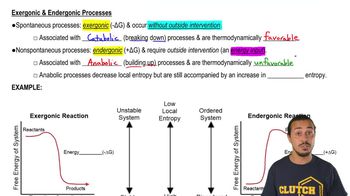
    Event occurring without external energy input, characterized by increased disorder and negative delta G.
  • Non-Spontaneous Process

    Event requiring external energy input, associated with decreased local disorder and positive delta G.
  • Delta G

    Change in Gibbs free energy, indicating whether a process is thermodynamically favorable or not.
  • Exergonic Reaction

    Energy-releasing event with decreased system energy, increased disorder, and negative delta G.
  • Endergonic Reaction

    Energy-absorbing event with increased system energy, decreased disorder, and positive delta G.
  • Catabolic Process

    Breakdown of larger molecules into smaller ones, increasing disorder and favoring energy release.
  • Anabolic Process

    Formation of larger molecules from smaller ones, decreasing local disorder but increasing universal disorder.
  • Equilibrium

    State where a system's potential energy is minimized and no net change occurs in energy distribution.
  • Thermal Energy

    Heat produced during energy conversions, contributing to increased universal disorder.
  • Stability

    Condition of a system with lower energy and higher disorder, often resulting from exergonic events.
  • Order

    Arrangement of components in a system with lower disorder, typically increased by endergonic events.