Back

Receptor Tyrosine Kinases quiz

Control buttons has been changed to "navigation" mode.
1/15
  • What is the main structural feature of receptor tyrosine kinases (RTKs) that allows them to function as biosignaling receptors?

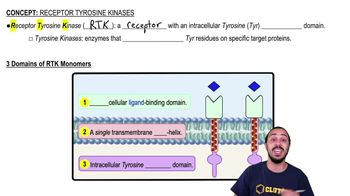
    RTKs are integral membrane proteins with an intracellular tyrosine kinase domain, enabling them to phosphorylate tyrosine residues on target proteins.
  • What typically triggers the dimerization of RTK monomers?

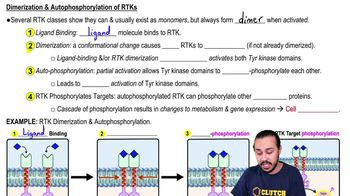
    Ligand binding to the extracellular domain causes conformational changes that bring two RTK monomers together, resulting in dimerization.
  • What is autophosphorylation in the context of RTKs?

    Autophosphorylation is when RTK monomers within a dimer phosphorylate each other's tyrosine residues, fully activating their kinase domains.
  • What are the three main domains found in RTK monomers?

    RTK monomers have an extracellular ligand binding domain, a single transmembrane alpha helix, and an intracellular tyrosine kinase domain.
  • What is the role of the extracellular ligand binding domain in RTKs?

    It binds to ligands (primary messengers) outside the cell, initiating RTK activation.
  • How does RTK activation lead to cellular responses?

    Activated RTKs phosphorylate target proteins, triggering a cascade of phosphorylation events that alter metabolism and gene expression.
  • What is the significance of SH2 domains in proteins interacting with RTKs?

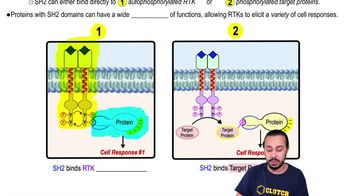
    SH2 domains allow proteins to bind specifically to phosphorylated tyrosine residues, linking RTKs to downstream signaling pathways.
  • Can SH2 domain-containing proteins bind to phosphorylated serine or threonine residues?

    No, SH2 domains only bind to phosphorylated tyrosine residues, not serine or threonine.
  • What are the two ways SH2 domain-containing proteins can interact with RTK signaling?

    They can bind directly to autophosphorylated RTKs or to phosphorylated target proteins of RTKs.
  • What is the result of RTK dimerization and autophosphorylation?

    It leads to full activation of the tyrosine kinase domains, enabling RTKs to phosphorylate other proteins.
  • How does ligand binding affect RTK monomers?

    Ligand binding induces conformational changes that promote dimerization and partial activation of the kinase domains.
  • What is the one-letter amino acid code for tyrosine, and why is it relevant to RTKs?

    The code is 'Y', and it is relevant because RTKs phosphorylate tyrosine residues during signaling.
  • What cellular changes can result from RTK signaling?

    RTK signaling can lead to changes in metabolism and gene expression, resulting in specific cellular responses.
  • Why can RTKs elicit a wide variety of cellular responses?

    Because proteins with SH2 domains have diverse functions, allowing RTKs to trigger multiple signaling pathways.
  • What is the function of the intracellular tyrosine kinase domain in RTKs?

    It acts as an enzyme that phosphorylates tyrosine residues on itself and on target proteins, propagating the signal.