Back

Receptor Tyrosine Kinases definitions

Control buttons has been changed to "navigation" mode.
1/15
  • Receptor Tyrosine Kinase

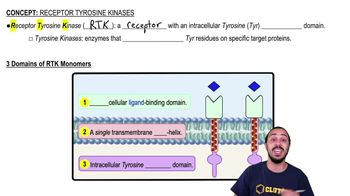
    Integral membrane protein with an intracellular domain that catalyzes phosphorylation of tyrosine residues, triggering cellular signaling cascades.
  • RTK Monomer

    Single protein subunit of a receptor tyrosine kinase, containing three distinct domains before activation and dimerization.
  • Ligand

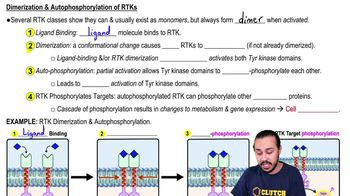
    Extracellular molecule that binds to the receptor's external domain, initiating conformational changes and activation.
  • Extracellular Ligand Binding Domain

    Region of the receptor located outside the cell membrane, responsible for recognizing and binding signaling molecules.
  • Transmembrane Alpha Helix

    Single helical structure spanning the cell membrane, anchoring the receptor and connecting external and internal domains.
  • Tyrosine Kinase Domain

    Intracellular region of the receptor with enzymatic activity, specifically phosphorylating tyrosine residues on proteins.
  • Dimerization

    Process where two receptor monomers associate to form a functional complex, often triggered by ligand binding.
  • Autophosphorylation

    Mutual phosphorylation of tyrosine residues between paired receptor domains, resulting in full activation of signaling.
  • Phosphorylation Cascade

    Series of sequential phosphorylation events initiated by activated receptors, leading to diverse cellular responses.
  • SH2 Domain

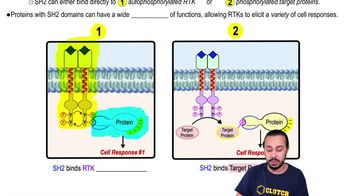
    Protein region that specifically recognizes and binds phosphorylated tyrosine residues, linking receptors to downstream effectors.
  • Phosphorylated Tyrosine Residue

    Tyrosine amino acid modified by the addition of a phosphate group, serving as a docking site for signaling proteins.
  • Target Protein

    Cellular molecule modified by receptor activity, often through phosphorylation, to propagate or regulate signaling pathways.
  • Cell Response

    Outcome of signaling events, such as changes in metabolism or gene expression, resulting from receptor activation.
  • Integral Membrane Protein

    Protein embedded within the cell membrane, possessing regions exposed to both extracellular and intracellular environments.
  • Amino Acid Residue

    Individual building block within a protein, often serving as a site for post-translational modifications like phosphorylation.