Back

Recap of Reversible Inhibition quiz

Control buttons has been changed to "navigation" mode.
1/15
  • What are the four main types of reversible enzyme inhibitors?

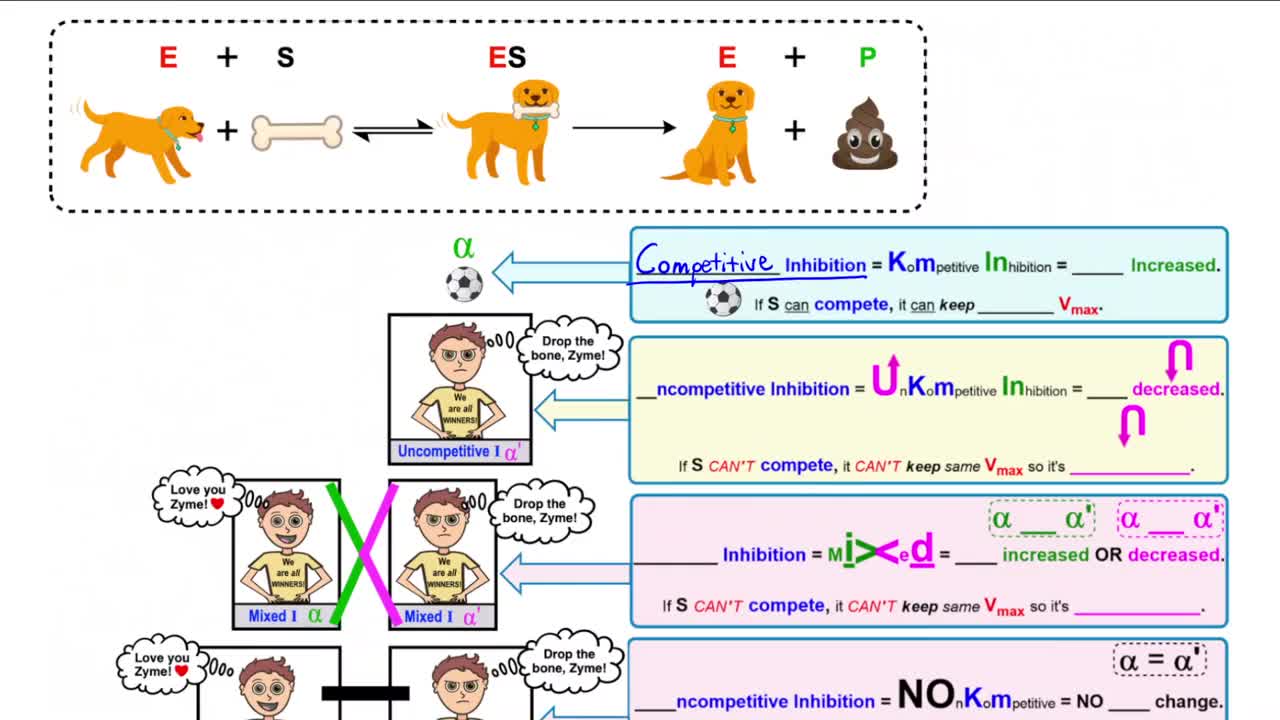
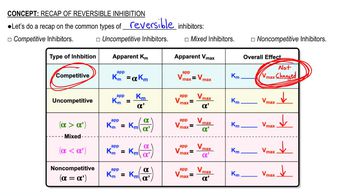
    The four types are competitive, uncompetitive, mixed, and noncompetitive inhibitors.
  • How does a competitive inhibitor affect Vmax and Km?

    A competitive inhibitor increases Km but does not change Vmax.
  • What is the effect of an uncompetitive inhibitor on Km and Vmax?

    An uncompetitive inhibitor decreases both Km and Vmax.
  • How do mixed inhibitors affect Vmax?

    Mixed inhibitors always decrease Vmax.
  • What determines whether a mixed inhibitor increases or decreases Km?

    Whether Km increases or decreases depends on whether the inhibitor binds more strongly to the free enzyme (alpha > alpha prime) or the enzyme-substrate complex (alpha < alpha prime).
  • How does a noncompetitive inhibitor affect Km and Vmax?

    A noncompetitive inhibitor decreases Vmax but does not change Km.
  • What unique feature distinguishes competitive inhibitors from other reversible inhibitors?

    Competitive inhibitors are the only ones that compete with the substrate for binding to the enzyme's active site.
  • Why can the effects of a competitive inhibitor be overcome by increasing substrate concentration?

    Because the substrate can outcompete the inhibitor for the active site at high concentrations, restoring Vmax.
  • To which form of the enzyme do uncompetitive inhibitors bind?

    Uncompetitive inhibitors bind only to the enzyme-substrate complex.
  • What is the relationship between Km and binding affinity?

    A higher Km means lower binding affinity, while a lower Km means higher binding affinity.
  • What is the effect of all reversible inhibitors (except competitive) on Vmax?

    All reversible inhibitors except competitive inhibitors decrease Vmax.
  • What does it mean if alpha equals alpha prime in mixed inhibition?

    If alpha equals alpha prime, the inhibitor is noncompetitive and Km is unchanged.
  • How do uncompetitive inhibitors affect the enzyme's catalytic efficiency?

    Uncompetitive inhibitors decrease both Km and Vmax, reducing overall catalytic efficiency.
  • What memory tool can help you remember the effect of uncompetitive inhibitors on Km?

    The 'U' in uncompetitive can remind you of a U-turn, indicating that Km decreases.
  • Why do all reversible inhibitors ultimately make the enzyme's performance worse?

    They either decrease Vmax, increase Km, or both, which reduces the enzyme's ability to catalyze reactions efficiently.