Back

Recap of Reversible Inhibition definitions

Control buttons has been changed to "navigation" mode.
1/14
  • Reversible Inhibition

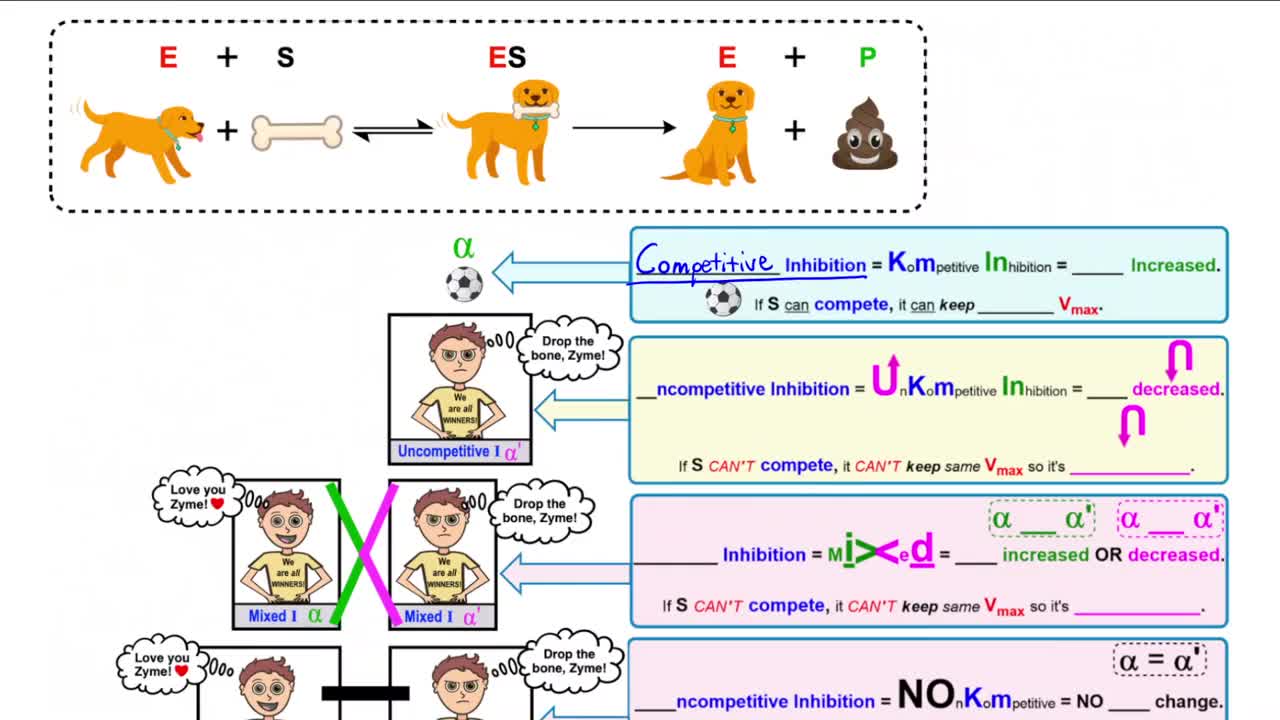
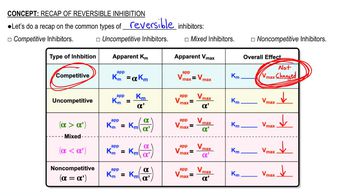
    Temporary reduction of enzyme activity, allowing normal function to resume once the inhibitor is removed.
  • Competitive Inhibitor

    Molecule that binds to the enzyme's active site, preventing substrate access and increasing Michaelis constant.
  • Uncompetitive Inhibitor

    Compound that attaches only to the enzyme-substrate complex, lowering both maximum velocity and Michaelis constant.
  • Mixed Inhibitor

    Agent that binds to either free enzyme or enzyme-substrate complex, always decreasing maximum velocity and altering Michaelis constant.
  • Noncompetitive Inhibitor

    Subtype of mixed inhibitor with equal affinity for free enzyme and enzyme-substrate complex, decreasing maximum velocity without affecting Michaelis constant.
  • Active Site

    Region on the enzyme where substrate molecules bind and undergo a chemical reaction.
  • Enzyme-Substrate Complex

    Temporary association formed when a substrate binds to an enzyme's active site.
  • Michaelis Constant

    Value reflecting substrate concentration required for half-maximal enzyme activity; inversely related to binding affinity.
  • Maximum Velocity

    Highest rate of an enzyme-catalyzed reaction when substrate concentration is saturating.
  • Alpha

    Symbol representing the degree of inhibition for binding to the free enzyme.
  • Alpha Prime

    Symbol indicating the degree of inhibition for binding to the enzyme-substrate complex.
  • Binding Affinity

    Strength of interaction between enzyme and substrate; higher values of Michaelis constant indicate weaker association.
  • Substrate

    Molecule upon which an enzyme acts, binding at the active site to form a product.
  • Product

    Resulting molecule formed after the enzyme catalyzes the substrate.