Back

Protein Motifs and Domains quiz

Control buttons has been changed to "navigation" mode.
1/15
  • What are protein motifs in the context of tertiary structure?

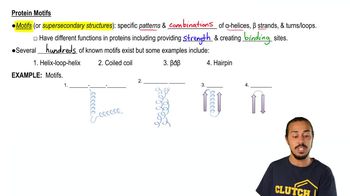
    Protein motifs are specific patterns and combinations of secondary structures, such as alpha helices and beta strands, that form super secondary structures with distinct functions.
  • How do protein domains differ from motifs?

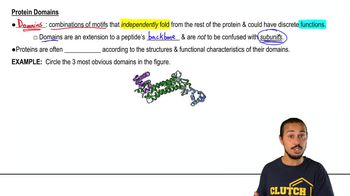
    Domains are combinations of motifs that form independently folding units within a single polypeptide chain, while motifs are patterns of secondary structures.
  • What is the main structural difference between a domain and a subunit?

    A domain is an extension of the peptide backbone within a single polypeptide chain, while a subunit is a completely separate polypeptide chain.
  • What is the function of the coiled coil motif?

    The coiled coil motif provides strength to proteins by winding two alpha helices around each other.
  • Describe the structure of a helix-loop-helix motif.

    A helix-loop-helix motif consists of two alpha helices connected by a loop.
  • What secondary structures are involved in the beta-alpha-beta motif?

    The beta-alpha-beta motif consists of a beta strand, followed by an alpha helix, and then another beta strand.
  • How are the beta strands arranged in a hairpin motif?

    In a hairpin motif, two beta strands run in antiparallel directions and are connected by a small loop.
  • Why are protein domains important for understanding protein function?

    Domains often have specific structural and functional characteristics, so identifying a known domain in a new protein can reveal insights about the protein's function.
  • Can a single polypeptide chain contain multiple domains?

    Yes, a single polypeptide chain can have multiple domains, each capable of independent folding.
  • What is the relationship between secondary structure, motifs, and domains?

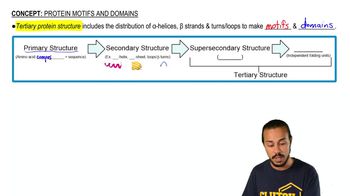
    Secondary structures combine to form motifs, and motifs combine to form domains, building up the hierarchy of protein structure.
  • What is a common function of protein motifs?

    Protein motifs can provide structural strength or create binding sites for other molecules.
  • How can studying domains help scientists with new proteins?

    If a known domain is found in a new protein, scientists can infer possible functions for the new protein based on what is known about that domain.
  • What does it mean for a domain to be an 'independently folding unit'?

    It means that a domain can fold into its proper structure even when separated from the rest of the protein.
  • What is the difference between an alpha helix and a coiled coil motif?

    An alpha helix is a single helical structure within one polypeptide chain, while a coiled coil is formed by two alpha helices twisted around each other.
  • Why is it important not to confuse domains with subunits?

    Because domains are parts of a single polypeptide chain, while subunits are separate chains that come together in quaternary structure.