Back

Protein Motifs and Domains definitions

Control buttons has been changed to "navigation" mode.
1/15
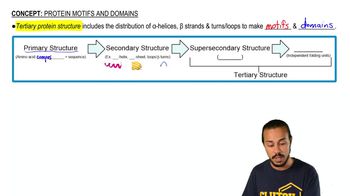
  • Tertiary Structure

    Three-dimensional arrangement formed by the combination of secondary structures, resulting in the overall shape of a protein.
  • Secondary Structure

    Local folding patterns within a polypeptide, including alpha helices, beta strands, beta turns, and loops.
  • Alpha Helix

    Spiral-shaped secondary structure stabilized by hydrogen bonds, often found in motifs and domains.
  • Beta Strand

    Extended, zigzag secondary structure that can pair with others to form beta sheets or motifs.
  • Beta Turn

    Short segment causing a reversal in polypeptide direction, often connecting secondary structures.
  • Loop

    Flexible, non-repetitive region connecting elements of secondary structure, often part of motifs.
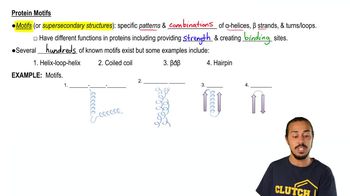
  • Motif

    Specific pattern of secondary structures forming super secondary structures with distinct functions.
  • Helix-Loop-Helix

    Motif consisting of two alpha helices separated by a loop, commonly involved in binding.
  • Coiled Coil

    Motif where two alpha helices wind around each other, providing structural strength.
  • Beta-Alpha-Beta

    Motif featuring a beta strand, an alpha helix, and another beta strand in sequence.
  • Hairpin Motif

    Motif with two antiparallel beta strands connected by a small loop, forming a tight turn.
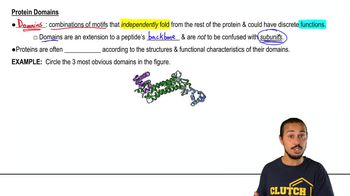
  • Domain

    Independently folding unit within a polypeptide, composed of motifs and capable of separate function.
  • Polypeptide Chain

    Linear sequence of amino acids forming the backbone of protein structure, containing domains and motifs.
  • Subunit

    Distinct polypeptide chain in a multi-chain protein, not connected to the backbone of other chains.
  • Peptide Backbone

    Continuous chain of amino acids forming the structural framework of a protein.