Back

Membrane Transport of Ions quiz

Control buttons has been changed to "navigation" mode.
1/15
  • What is the main factor that determines the direction of charged ion diffusion across membranes?

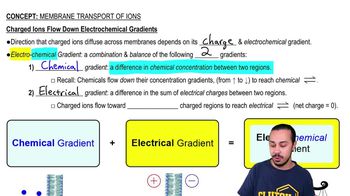
    Charged ions diffuse down their electrochemical gradients, which are determined by both their charge and the balance of chemical and electrical gradients.
  • What is the chemical gradient in membrane transport?

    The chemical gradient refers to the difference in chemical concentration between two regions, causing molecules to move from high to low concentration.
  • How do ions move in response to the chemical gradient?

    Ions move from areas of high concentration to areas of low concentration until chemical equilibrium is reached.
  • What is the electrical gradient in membrane transport?

    The electrical gradient is the difference in net electrical charge between two regions, influencing the movement of charged ions toward oppositely charged areas.
  • How do charged ions respond to the electrical gradient?

    Charged ions move toward regions with opposite charge, continuing until electrical equilibrium is achieved.
  • What is the electrochemical gradient?

    The electrochemical gradient is the combined effect of the chemical and electrical gradients, determining the overall direction of ion movement.
  • How do uncharged molecules move across membranes?

    Uncharged molecules only respond to the chemical gradient and move from high to low concentration.
  • What is the transmembrane potential (Delta Psi)?

    Transmembrane potential is the difference in electrical charge across a cell's plasma membrane, usually negative inside relative to outside.
  • How is the sign of transmembrane potential determined?

    The sign depends on which side is considered final and initial; inside minus outside gives a negative value, while outside minus inside gives a positive value.
  • What is the typical value of transmembrane potential in cells?

    The inside of cells is usually more negative than the outside, so transmembrane potential is typically negative, such as -70 millivolts in neurons.
  • What happens when transmembrane potential is not zero?

    A nonzero transmembrane potential establishes electrical gradients for cations and anions in opposite directions.
  • What are the five types of ion channels?

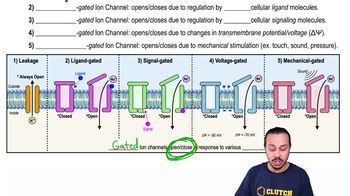
    The five types are leakage, ligand-gated, signal-gated, voltage-gated, and mechanical-gated ion channels.
  • What is a leakage ion channel?

    Leakage ion channels remain open, allowing continuous passive diffusion of ions down their electrochemical gradients.
  • How do ligand-gated ion channels operate?

    Ligand-gated ion channels open in response to binding of an extracellular ligand, allowing ions to pass through.
  • What triggers the opening of mechanical-gated ion channels?

    Mechanical-gated ion channels open in response to mechanical stimuli such as touch, sound, or pressure.