Back

Membrane Transport of Ions definitions

Control buttons has been changed to "navigation" mode.
1/14
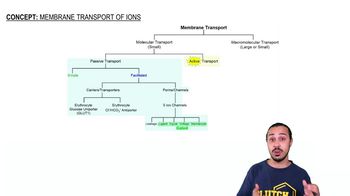
  • Passive Transport

    Movement of molecules across membranes without energy input, relying on concentration or electrochemical gradients.
  • GLUT 1

    Membrane protein in erythrocytes facilitating glucose transport via passive diffusion.
  • Chloride Bicarbonate Antiporter

    Carrier protein in erythrocytes exchanging chloride and bicarbonate ions across the membrane.
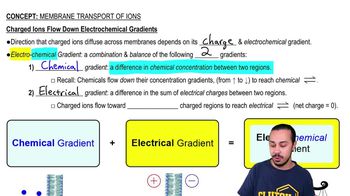
  • Electrochemical Gradient

    Combined effect of concentration and electrical charge differences driving ion movement across membranes.
  • Chemical Gradient

    Difference in molecule concentration between two regions, influencing diffusion direction.
  • Electrical Gradient

    Difference in net electrical charge across a membrane, affecting movement of charged ions.
  • Transmembrane Potential

    Difference in electrical charge between the inside and outside of a cell's plasma membrane, often negative inside.
  • Cation

    Positively charged ion attracted to negatively charged regions across membranes.
  • Anion

    Negatively charged ion attracted to positively charged regions across membranes.
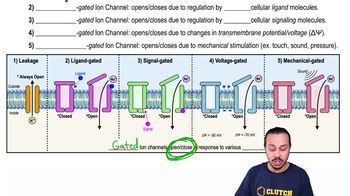
  • Leakage Ion Channel

    Membrane channel that remains open, allowing continuous ion flow down electrochemical gradients.
  • Ligand-Gated Ion Channel

    Channel regulated by extracellular ligand binding, enabling selective ion passage.
  • Signal-Gated Ion Channel

    Channel regulated by intracellular signaling molecules, controlling ion movement.
  • Voltage-Gated Ion Channel

    Channel responsive to changes in transmembrane potential, opening or closing to allow ion flow.
  • Mechanical-Gated Ion Channel

    Channel activated by mechanical stimuli such as touch or sound, permitting ion transport.