Back

Liver vs Muscle Glycogen Phosphorylase quiz

Control buttons has been changed to "navigation" mode.
1/15
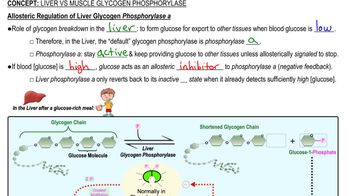
  • What is the primary role of glycogen breakdown in the liver?

    The primary role is to form glucose for export to other tissues when blood glucose is low.
  • Which form is the default active state of liver Glycogen Phosphorylase?

    The default active state is Phosphorylase a.
  • What acts as an allosteric inhibitor of liver Glycogen Phosphorylase a?

    High blood glucose acts as an allosteric inhibitor via negative feedback.
  • What happens to liver Glycogen Phosphorylase a after a glucose-rich meal?

    It transitions from its active r state to its inactive b t state due to allosteric inhibition by glucose.
  • What additional process is required for liver Glycogen Phosphorylase to switch from a to b form?

    A covalent modification is required, involving complex hormonal regulation.
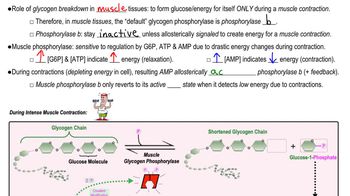
  • What is the main function of glycogen breakdown in muscle tissue?

    It provides glucose and energy for the muscle itself, especially during muscle contraction.
  • Which form is the default state of muscle Glycogen Phosphorylase?

    The default state is Glycogen Phosphorylase b, which is normally inactive.
  • What molecule allosterically activates muscle Glycogen Phosphorylase b during contraction?

    AMP allosterically activates it via positive feedback during muscle contraction.
  • What do high levels of ATP and G6P indicate in muscle cells?

    They indicate high energy and are associated with muscle relaxation.
  • How do ATP and G6P affect muscle Glycogen Phosphorylase a?

    They allosterically inhibit it, converting it back to its inactive state via negative feedback.
  • Why is liver Glycogen Phosphorylase insensitive to ATP, G6P, and AMP regulation?

    Because the liver does not undergo drastic energy changes like muscle cells do.
  • What is the effect of muscle contraction on ATP and AMP levels?

    Muscle contraction depletes ATP and increases AMP levels.
  • What is the result of AMP binding to muscle Glycogen Phosphorylase b?

    AMP binding allosterically activates the enzyme, promoting glycogen breakdown.
  • What is the main difference in allosteric regulation between liver and muscle Glycogen Phosphorylase?

    Liver enzyme is regulated by blood glucose, while muscle enzyme is regulated by cellular energy status (ATP, G6P, AMP).
  • What type of feedback does glucose provide to liver Glycogen Phosphorylase a?

    Glucose provides negative feedback by acting as an allosteric inhibitor.