Back

Isoelectric Point of a Peptide quiz

Control buttons has been changed to "navigation" mode.
1/15
  • What is the isoelectric point (pI) of a peptide?

    The isoelectric point is the pH at which a peptide has a net charge of zero.
  • How is the pI of a peptide calculated?

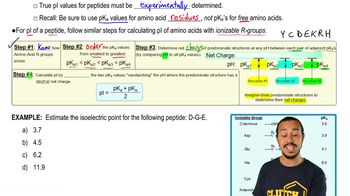
    The pI is calculated by averaging the two pKa values that sandwich the neutral net charge.
  • Why can the pI and net charge of a peptide only be estimated?

    They can only be estimated because the unique microenvironment of each residue can shift pKa values.
  • Which set of pKa values should be used for accurate pI calculations in peptides?

    You should use the pKa values specific to amino acid residues, not free amino acids.
  • What is the mnemonic for remembering the seven amino acids with ionizable R groups?

    The mnemonic is 'yucky crazy dragons knights riding horses.'
  • What are the four steps to calculate the isoelectric point of a peptide?

    Identify ionizable R groups, order pKa values, determine net charge at various pH levels, and average the relevant pKa values.
  • Why do we only consider ionizable groups when calculating the pI of a peptide?

    Only ionizable groups contribute to the net charge and thus affect the isoelectric point.
  • What are the pKa values for the C-terminus, aspartic acid, glutamic acid, and N-terminus in the peptide DGE?

    C-terminus: 3.5, aspartic acid: 3.9, glutamic acid: 4.1, N-terminus: 8.0.
  • At what pH does the peptide DGE have a net charge of zero?

    At pH 3.6, the peptide DGE has a net charge of zero.
  • Which two pKa values are averaged to calculate the pI of DGE?

    The pKa values of 3.5 (C-terminus) and 3.9 (aspartic acid) are averaged.
  • What is the calculated pI for the peptide DGE?

    The calculated pI for DGE is 3.7.
  • How does the net charge of a peptide change when crossing a pKa value from left to right?

    The net charge decreases by one unit when crossing a pKa from left to right.
  • What is the charge of the amino group at a pH lower than its pKa?

    The amino group is positively charged (NH3+) when the pH is lower than its pKa.
  • What is the charge of aspartic acid’s R group at a pH lower than its pKa?

    Aspartic acid’s R group is neutral at a pH lower than its pKa.
  • Why is it important to order pKa values from smallest to largest when calculating pI?

    Ordering pKa values helps identify the pH ranges where the net charge changes and locate the neutral net charge.