Back

Isoelectric Point of a Peptide definitions

Control buttons has been changed to "navigation" mode.
1/15
  • Isoelectric Point

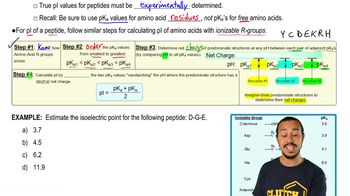
    pH at which a peptide has a net charge of zero, determined by averaging two pKa values that bracket the neutral charge.
  • pKa

    Value indicating the pH at which an ionizable group is half dissociated; crucial for predicting charge states in peptides.
  • Peptide

    Chain of amino acid residues linked by peptide bonds, with ionizable groups affecting its net charge and isoelectric point.
  • Amino Acid Residue

    Component of a peptide, each with unique microenvironment and pKa values that influence the peptide's overall properties.
  • Ionizable R Group

    Side chain in certain amino acids capable of gaining or losing protons, impacting the peptide's net charge at different pH.
  • Net Charge

    Sum of charges from all ionizable groups in a peptide at a specific pH, used to identify the isoelectric point.
  • C-Terminus

    End of a peptide with a free carboxyl group, often contributing a negative charge and possessing a distinct pKa.
  • N-Terminus

    End of a peptide with a free amino group, typically contributing a positive charge and having its own pKa value.
  • Conjugate Acid

    Form of an ionizable group that predominates when pH is below its pKa, often carrying a positive or neutral charge.
  • Conjugate Base

    Form of an ionizable group that predominates when pH is above its pKa, usually carrying a negative charge.
  • Microenvironment

    Local surroundings of an amino acid residue within a peptide, capable of shifting pKa values and affecting charge.
  • Aspartic Acid

    Amino acid with an ionizable R group, contributing a negative charge at higher pH and a neutral charge at lower pH.
  • Glutamic Acid

    Amino acid with an ionizable R group, similar to aspartic acid, affecting peptide charge based on pH and its pKa.
  • Glycine

    Amino acid lacking an ionizable R group, not contributing to net charge changes in peptide isoelectric point calculations.
  • Predominant Structure

    Most stable form of a peptide at a given pH, determined by the charge states of its ionizable groups.