Skip to main content
Biochemistry
My Course
Learn
Exam Prep
AI Tutor
Study Guides
Flashcards
Explore
Try the app
My Course
Learn
Exam Prep
AI Tutor
Study Guides
Flashcards
Explore
Try the app
Back
Autoionization of Water quiz
You can tap to flip the card.
What ions are formed when water undergoes autoionization?
You can tap to flip the card.
👆
What ions are formed when water undergoes autoionization?
Hydronium ions (H3O+) and hydroxide ions (OH−) are formed.
Track progress
Control buttons has been changed to "navigation" mode.
1/15
Related flashcards
Related practice
Recommended videos
Autoionization of Water definitions
Autoionization of Water
15 Terms
Autoionization of Water
2. Water
7 problems
Topic
pH
2. Water
7 problems
Topic
2. Water - Part 1 of 3
4 topics
11 problems
Chapter
2. Water - Part 2 of 3
5 topics
11 problems
Chapter
2. Water - Part 3 of 3
4 topics
11 problems
Chapter
Guided course
02:25
Proton Hopping
3
views
Guided course
04:04
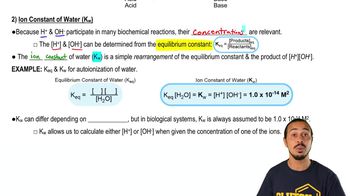
Ion Constant of Water (Kw)
6
views
Guided course
04:26
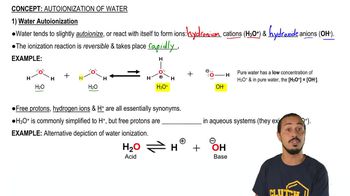
Water Autoionization
4
views
Terms in this set (15)
Hide definitions
What ions are formed when water undergoes autoionization?
Hydronium ions (H3O+) and hydroxide ions (OH−) are formed.
Is the autoionization of water a reversible reaction?
Yes, it is a reversible reaction, meaning it can proceed in both directions.
In pure water, how do the concentrations of H3O+ and OH− compare?
The concentrations of H3O+ and OH− are always equal in pure water.
What is the ion constant of water (Kw) at 298 K?
Kw is 1 × 10⁻¹⁴ M² at 298 K.
How is Kw calculated from the concentrations of ions?
Kw = [H⁺][OH⁻], which is the product of the concentrations of H⁺ and OH⁻ ions.
Why are free protons (H⁺) considered nonexistent in aqueous solutions?
Because in water, protons exist as hydronium ions (H3O+), not as free H⁺.
What is proton hopping in the context of water autoionization?
Proton hopping is the rapid transfer of protons between water molecules, allowing H3O+ and OH− to diffuse quickly.
Why do we often use H⁺ instead of H3O+ in equations?
H⁺ is a simplified notation for H3O+, but in reality, protons are always associated with water as H3O+.
How does the equilibrium constant relate to the ion constant of water?
The ion constant (Kw) is derived from the equilibrium constant by multiplying by the concentration of water.
Why is Kw important in biological systems?
Kw allows us to calculate the concentration of H⁺ or OH⁻ in biological solutions, which is crucial for understanding pH and biochemical reactions.
How does temperature affect Kw?
Kw varies with temperature, but in biological systems, it is typically assumed to be 1 × 10⁻¹⁴ M² at 298 K.
What happens to the concentration of water compared to H3O+ and OH− during autoionization?
The concentration of water remains much larger than the concentrations of H3O+ and OH−.
What is the significance of the equilibrium arrows in the autoionization reaction?
They indicate that the reaction is reversible and that the formation of ions is much less favored than the reverse.
Why do H3O+ and OH− diffuse faster than other ions in water?
Because they can move via proton hopping, which is faster than physical diffusion.
How does knowing Kw help limit memorization in acid-base chemistry?
By memorizing Kw, you don't need to memorize separate values for the equilibrium constant or water concentration.
 BackBack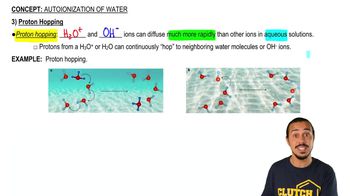
 02:25
02:25