Skip to main content
Biochemistry
My Course
Learn
Exam Prep
AI Tutor
Study Guides
Flashcards
Explore
Try the app
My Course
Learn
Exam Prep
AI Tutor
Study Guides
Flashcards
Explore
Try the app
Back
Autoionization of Water definitions
You can tap to flip the card.
Autoionization
You can tap to flip the card.
👆
Autoionization
Spontaneous formation of ions when water molecules interact, producing hydronium and hydroxide in a reversible equilibrium.
Track progress
Control buttons has been changed to "navigation" mode.
1/15
Related flashcards
Related practice
Recommended videos
Autoionization of Water quiz
Autoionization of Water
15 Terms
Autoionization of Water
2. Water
7 problems
Topic
pH
2. Water
7 problems
Topic
2. Water - Part 1 of 3
4 topics
11 problems
Chapter
2. Water - Part 2 of 3
5 topics
11 problems
Chapter
2. Water - Part 3 of 3
4 topics
11 problems
Chapter
Guided course
02:25
Proton Hopping
3
views
Guided course
04:04
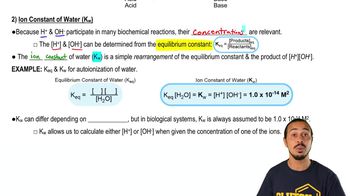
Ion Constant of Water (Kw)
6
views
Guided course
04:26
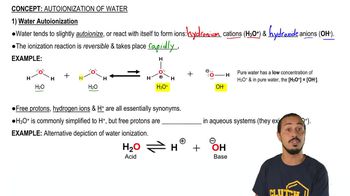
Water Autoionization
4
views
Terms in this set (15)
Hide definitions
Autoionization
Spontaneous formation of ions when water molecules interact, producing hydronium and hydroxide in a reversible equilibrium.
Hydronium
A positively charged ion formed when a water molecule gains a proton, representing the actual form of H+ in aqueous solutions.
Hydroxide
A negatively charged ion resulting from water losing a proton, crucial for maintaining pH balance in biological systems.
Cation
An ion with a positive charge, such as hydronium, important in acid-base chemistry and solution dynamics.
Anion
An ion with a negative charge, like hydroxide, essential for understanding water's ionization and pH regulation.
Equilibrium
A state where the forward and reverse reactions occur at equal rates, maintaining constant ion concentrations in water.
Ion Constant of Water
A value representing the product of hydronium and hydroxide concentrations, fixed at 1×10⁻¹⁴ mol² at 298 K.
Kw
A symbol for the ion constant of water, used to calculate ion concentrations and understand acid-base equilibria.
Proton Hopping
A mechanism enabling rapid movement of hydronium and hydroxide ions through water by transferring protons between molecules.
Diffusion
The process by which ions spread throughout a solution, accelerated for hydronium and hydroxide via proton hopping.
Aqueous Solution
A mixture where water is the solvent, allowing autoionization and supporting acid-base reactions.
pH
A measure of hydrogen ion concentration, influenced by the equilibrium between hydronium and hydroxide in water.
Acid-Base Chemistry
The study of proton transfer reactions, relying on the behavior of hydronium and hydroxide in water.
298 K
A standard temperature for biological systems, at which the ion constant of water is typically referenced.
Equilibrium Constant
A ratio of product to reactant concentrations at equilibrium, foundational for calculating Kw in water autoionization.
 BackBack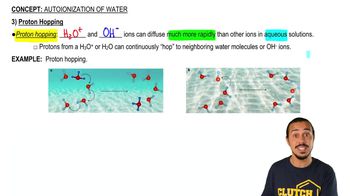
 02:25
02:25