Back

Inhibitory Adenylate Cyclase GPCR Signaling quiz

Control buttons has been changed to "navigation" mode.
1/15
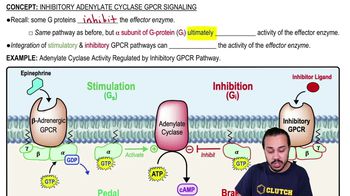
  • What is the main function of the inhibitory alpha subunit (Gi) in adenylate cyclase GPCR signaling?

    The inhibitory alpha subunit (Gi) reduces the activity of adenylate cyclase, leading to decreased production of cAMP.
  • How does the stimulatory GPCR pathway differ from the inhibitory GPCR pathway in regulating adenylate cyclase?

    The stimulatory pathway activates adenylate cyclase to increase cAMP, while the inhibitory pathway inhibits adenylate cyclase to decrease cAMP.
  • What analogy is used to describe the roles of stimulatory and inhibitory GPCR pathways in regulating adenylate cyclase?

    The stimulatory pathway is like a gas pedal speeding up adenylate cyclase, and the inhibitory pathway is like brakes slowing it down.
  • What happens to cAMP levels when the inhibitory GPCR pathway is activated?

    cAMP levels decrease because adenylate cyclase activity is inhibited.
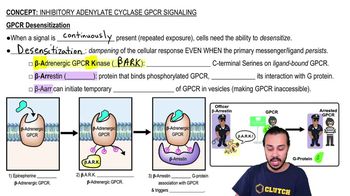
  • What is GPCR desensitization?

    GPCR desensitization is the process where the cellular response to a continuously present signal decreases, even if the ligand remains bound.
  • Which kinase is responsible for phosphorylating the ligand-bound beta adrenergic GPCR during desensitization?

    Beta adrenergic GPCR kinase (BARK) phosphorylates the ligand-bound beta adrenergic GPCR.
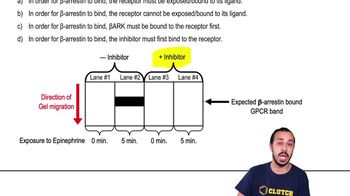
  • What is the role of beta arrestin in GPCR desensitization?

    Beta arrestin binds to the phosphorylated GPCR, blocking its interaction with G proteins and potentially initiating endocytosis.
  • What is the first step in GPCR desensitization?

    The first step is the binding of a continuously present ligand to the beta adrenergic GPCR.
  • What does BARK do after the ligand binds to the beta adrenergic GPCR?

    BARK phosphorylates the ligand-bound beta adrenergic GPCR on specific serine residues.
  • How does beta arrestin contribute to the removal of GPCRs from the cell surface?

    Beta arrestin can trigger temporary endocytosis, removing the GPCR from the plasma membrane.
  • Why is desensitization important for cells exposed to continuous signals?

    Desensitization prevents overstimulation and allows the cell to dampen its response to persistent signals.
  • What happens to the interaction between GPCRs and G proteins when beta arrestin binds?

    Beta arrestin blocks the GPCR's interaction with G proteins, preventing further signaling.
  • What is the effect of endocytosis on GPCR signaling?

    Endocytosis makes the GPCR temporarily inaccessible to ligands, further reducing signaling.
  • What is the significance of the 'rogue GPCR' analogy in desensitization?

    It illustrates how BARK and beta arrestin work together to 'arrest' an overactive GPCR, stopping excessive signaling.
  • How do stimulatory and inhibitory GPCR pathways work together to regulate cellular responses?

    They integrate to fine-tune adenylate cyclase activity, ensuring the cell produces the appropriate amount of cAMP.