Back

Glucose and Glycogen Regulation Practice 1 quiz

Control buttons has been changed to "navigation" mode.
1/15
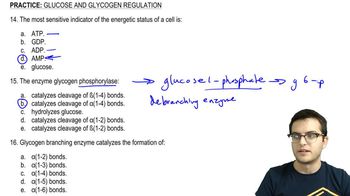
  • What is the most sensitive indicator of a cell's energetic status?

    AMP is the most sensitive indicator because its concentration fluctuates greatly compared to ADP and ATP.
  • Which enzyme breaks down glycogen by cleaving alpha-1,4 bonds?

    Glycogen phosphorylase breaks down glycogen by cleaving alpha-1,4 bonds.
  • What is the product released when glycogen phosphorylase acts on glycogen?

    The product is glucose-1-phosphate, which must be converted to glucose-6-phosphate.
  • Which enzyme assists glycogen phosphorylase by removing branch point glucoses?

    The debranching enzyme assists by removing branch point glucoses.
  • What type of bond does the glycogen branching enzyme form?

    It forms alpha-1,6 bonds, which are the branch points in glycogen.
  • How does the glycogen branching enzyme create branches in glycogen?

    It transfers about 6 to 10 glucose subunits to the 6th position of a glucose on another chain.
  • What is the role of glycogenin in glycogen synthesis?

    Glycogenin serves as the primer for glycogen synthesis, with initial sugars attached to its tyrosine residues.
  • How does glucose affect glycogen phosphorylase A?

    Glucose allosterically inhibits glycogen phosphorylase A by exposing its phosphate groups for deactivation.
  • What is the active form of glycogen phosphorylase called?

    The active form is called glycogen phosphorylase A, which is the phosphorylated form with two phosphate groups.
  • How does glucose lead to the deactivation of glycogen phosphorylase?

    Glucose exposes the phosphate groups on glycogen phosphorylase, allowing another enzyme to remove them and deactivate it.
  • Which enzyme is inhibited by ATP in glycolysis regulation?

    Phosphofructokinase-2 (PFK-2) is inhibited by ATP.
  • What does phosphofructokinase-2 produce to activate PFK1?

    It produces fructose-2,6-bisphosphate, which activates PFK1.
  • Why does ATP inhibit phosphofructokinase-2?

    ATP is a downstream product of glycolysis, so it acts as a negative feedback inhibitor of PFK-2.
  • What is the function of PFK1 in glycolysis?

    PFK1 promotes glycolysis by catalyzing a key regulatory step in the pathway.
  • How does glycolysis contribute to ATP production?

    Glycolysis directly produces ATP and also generates intermediates for further ATP production via the citric acid cycle and electron transport chain.