Back

Erythrocyte Facilitated Transporter Models quiz

Control buttons has been changed to "navigation" mode.
1/15
  • What type of transporter is GLUT1 and what does it transport?

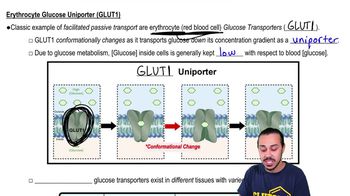
    GLUT1 is a glucose uniporter that transports glucose across the erythrocyte membrane.
  • How does GLUT1 move glucose across the membrane?

    GLUT1 undergoes conformational changes to transport glucose down its concentration gradient.
  • Why is the concentration of glucose lower inside erythrocytes compared to the blood?

    Glucose is constantly metabolized inside cells, keeping its intracellular concentration low.
  • What is the main biological role of GLUT1 in erythrocytes?

    GLUT1 supports basal glucose uptake, allowing erythrocytes to import glucose for energy.
  • What is an antiporter, and which antiporter is found in erythrocytes?

    An antiporter transports two molecules in opposite directions; the chloride bicarbonate antiporter is found in erythrocytes.
  • What is the chloride shift?

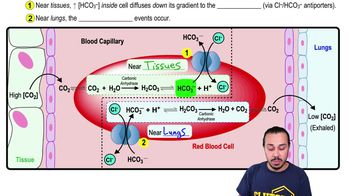
    The chloride shift is the exchange of chloride and bicarbonate ions across the erythrocyte membrane to maintain charge balance and facilitate CO2 transport.
  • What enzyme in erythrocytes converts CO2 and water into bicarbonate?

    Carbonic anhydrase converts CO2 and water into bicarbonate inside erythrocytes.
  • How does the chloride bicarbonate antiporter help maintain blood pH?

    By exchanging bicarbonate and chloride, the antiporter helps buffer blood pH and maintain enzyme structure.
  • What happens to bicarbonate and chloride ions near the tissues?

    Near the tissues, bicarbonate leaves the erythrocyte and chloride enters the cell via the antiporter.
  • What happens to bicarbonate and chloride ions near the lungs?

    Near the lungs, bicarbonate enters the erythrocyte and chloride leaves the cell, reversing the process seen near the tissues.
  • Why is the chloride shift important for CO2 transport?

    The chloride shift increases the blood's capacity to carry CO2 from tissues to the lungs for exhalation.
  • What is the main function of the chloride bicarbonate antiporter in erythrocytes?

    Its main function is to exchange bicarbonate and chloride ions to facilitate CO2 removal and maintain charge balance.
  • How does the direction of bicarbonate movement differ between tissues and lungs?

    Bicarbonate moves out of erythrocytes near tissues and into erythrocytes near the lungs.
  • What is meant by facilitated passive transport?

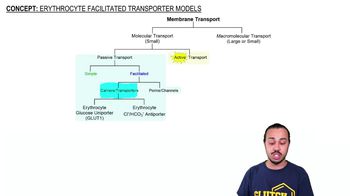
    Facilitated passive transport is the movement of molecules across membranes via specific transport proteins, down their concentration gradients, without energy input.
  • Why are there multiple types of glucose transporters in the body?

    Different glucose transporters are expressed in various tissues to fulfill specific functional roles in glucose uptake.