Back

Endocytosis & Exocytosis quiz

Control buttons has been changed to "navigation" mode.
1/15
  • What types of molecules require endocytosis or exocytosis for transport across cell membranes?

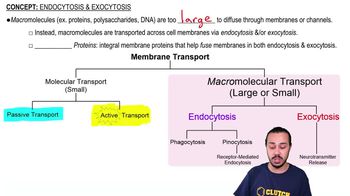
    Large macromolecules such as proteins, polysaccharides, and DNA require endocytosis or exocytosis because they cannot diffuse through membranes.
  • What is the main function of fusion proteins in membrane transport?

    Fusion proteins are integral membrane proteins that facilitate the fusion of membranes during endocytosis and exocytosis.
  • How is endocytosis defined?

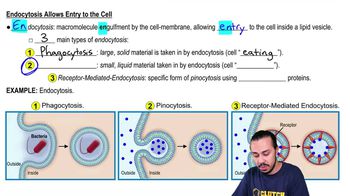
    Endocytosis is the engulfment of macromolecules by the cell membrane, forming a lipid vesicle for entry into the cell.
  • What are the three main types of endocytosis?

    The three main types are phagocytosis, pinocytosis, and receptor-mediated endocytosis.
  • What is phagocytosis and what does it transport?

    Phagocytosis is cellular eating, where large and solid materials like bacteria are taken up by the cell.
  • What is pinocytosis and what does it transport?

    Pinocytosis is cellular drinking, where small and liquid materials are taken up by the cell.
  • How does receptor-mediated endocytosis differ from pinocytosis?

    Receptor-mediated endocytosis is a specific form of pinocytosis that uses receptor proteins to selectively take up materials.
  • Which type of endocytosis is used by white blood cells for immunity?

    Phagocytosis is used by white blood cells to engulf harmful bacteria for immune protection.
  • What is the main function of exocytosis?

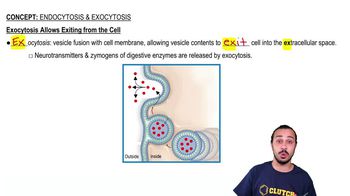
    Exocytosis allows vesicle contents to exit the cell by fusing the vesicle with the cell membrane and releasing the contents into the extracellular space.
  • What types of substances are commonly released by exocytosis?

    Neurotransmitters and zymogens of digestive enzymes are commonly released by exocytosis.
  • What does the 'EX' in exocytosis stand for?

    The 'EX' in exocytosis stands for exit and extracellular space, indicating the release of contents from the cell.
  • Why can't macromolecules use passive or active transport to cross membranes?

    Macromolecules are too large to diffuse through membranes or channels, so they require endocytosis or exocytosis.
  • What happens to the cell membrane during exocytosis?

    During exocytosis, the vesicle fuses with the cell membrane, allowing its contents to be released outside the cell.
  • What is the role of receptor proteins in receptor-mediated endocytosis?

    Receptor proteins selectively bind specific molecules, facilitating their uptake into the cell via endocytosis.
  • How does the cell bring in nutrients through endocytosis?

    The cell can use phagocytosis to engulf large nutrient particles or pinocytosis to take in small, liquid nutrients.