Back

Drugs & Toxins Affecting GPCR Signaling quiz

Control buttons has been changed to "navigation" mode.
1/15
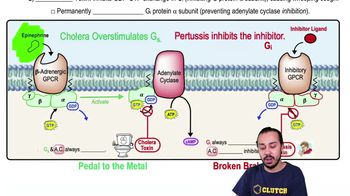
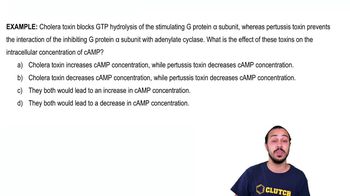
  • What enzyme's activity is increased by both cholera and pertussis toxins?

    Adenylate cyclase activity is increased by both cholera and pertussis toxins.
  • How does cholera toxin affect the Gs protein?

    Cholera toxin inhibits the GTPase activity of the Gs protein, keeping it permanently active.
  • What disease is caused by cholera toxin?

    Cholera toxin causes cholera, which is characterized by extreme diarrhea and dehydration.
  • What is the normal function of GTPase activity in G proteins?

    GTPase activity cleaves GTP to GDP, inactivating the G protein.
  • What happens to adenylate cyclase activity when Gs is permanently active?

    Adenylate cyclase is overstimulated, leading to increased production of cAMP.
  • How does pertussis toxin affect the Gi protein?

    Pertussis toxin inhibits the GDP-GTP exchange in Gi, keeping it permanently inactive.
  • What disease is caused by pertussis toxin?

    Pertussis toxin causes whooping cough.
  • What is the normal function of the Gi protein in GPCR signaling?

    The Gi protein inhibits adenylate cyclase, reducing cAMP production.
  • How does pertussis toxin indirectly increase adenylate cyclase activity?

    By keeping Gi inactive, pertussis toxin prevents inhibition of adenylate cyclase, increasing its activity.
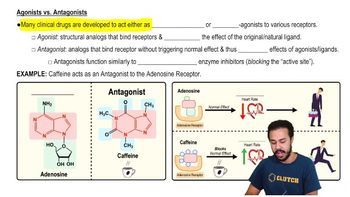
  • What is an agonist in the context of receptor signaling?

    An agonist is a structural analog that mimics the effect of a natural ligand by binding to the receptor.
  • What is an antagonist in the context of receptor signaling?

    An antagonist is a structural analog that binds to the receptor but blocks the effect of the natural ligand.
  • How do antagonists function similarly to competitive enzyme inhibitors?

    Antagonists compete with the natural ligand for receptor binding, blocking the ligand's effect.
  • What effect does adenosine binding to its receptor have on heart rate?

    Adenosine binding decreases heart rate, leading to drowsiness.
  • How does caffeine act on the adenosine receptor?

    Caffeine acts as an antagonist, blocking adenosine from binding and increasing heart rate and wakefulness.
  • Why does caffeine make people feel more awake?

    Caffeine blocks adenosine's effect of decreasing heart rate, resulting in increased heart rate and wakefulness.