Back

Drugs & Toxins Affecting GPCR Signaling definitions

Control buttons has been changed to "navigation" mode.
1/15
  • GPCR

    Membrane protein that transmits signals from extracellular ligands to intracellular pathways, often activating G proteins.
  • Adenylate Cyclase

    Effector enzyme that catalyzes conversion of ATP to cAMP, amplifying cellular signals in GPCR pathways.
  • G Protein

    Intracellular signaling molecule with alpha, beta, and gamma subunits, mediating effects of activated GPCRs.
  • cAMP

    Secondary messenger produced by adenylate cyclase, relaying signals to activate downstream effectors like PKA.
  • PKA

    Protein kinase activated by cAMP, phosphorylating target proteins to regulate cellular responses.
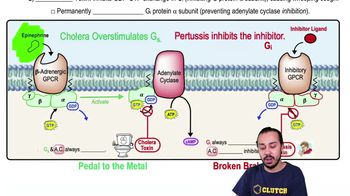
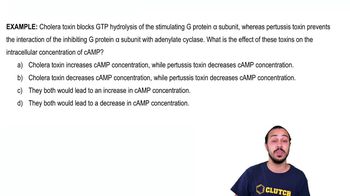
  • Cholera Toxin

    Bacterial protein that inhibits GTPase activity of Gs, causing persistent activation of adenylate cyclase.
  • Pertussis Toxin

    Bacterial protein that blocks GDP-GTP exchange in Gi, preventing inhibition of adenylate cyclase.
  • Gs

    Stimulatory G protein alpha subunit that activates adenylate cyclase when bound to GTP.
  • Gi

    Inhibitory G protein alpha subunit that suppresses adenylate cyclase activity when active.
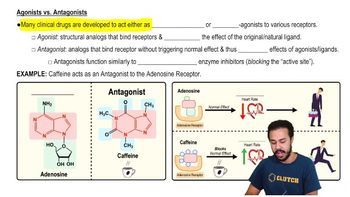
  • Agonist

    Structural analog that binds a receptor and mimics the effect of a natural ligand, triggering a cellular response.
  • Antagonist

    Structural analog that binds a receptor but blocks the effect of a natural ligand, preventing a response.
  • Adenosine Receptor

    GPCR that mediates effects of adenosine, such as decreased heart rate and drowsiness.
  • Caffeine

    Molecule acting as an antagonist at adenosine receptors, blocking drowsiness and increasing heart rate.
  • GDP-GTP Exchange

    Process by which G proteins switch from inactive GDP-bound to active GTP-bound states, enabling signal transmission.
  • GTPase Activity

    Intrinsic function of G proteins that hydrolyzes GTP to GDP, terminating signal transduction.