Back

Degree of Inhibition quiz

Control buttons has been changed to "navigation" mode.
1/15
  • What does the degree of inhibition quantify in enzyme kinetics?

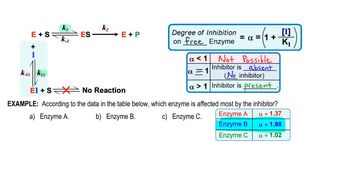
    It quantifies how much an enzyme is inhibited by an inhibitor, affecting the initial reaction velocity (v naught).
  • What is the Greek variable used to represent the degree of inhibition on the free enzyme?

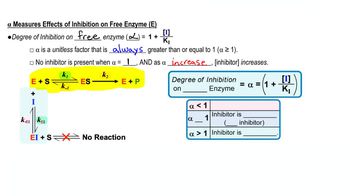
    The Greek variable alpha (α) is used to represent the degree of inhibition on the free enzyme.
  • How is alpha (α) calculated for the free enzyme?

    Alpha is calculated as 1 plus the ratio of the concentration of inhibitor to the inhibition constant: α = 1 + [I]/K_I.
  • What does an alpha (α) value of 1 indicate?

    An alpha value of 1 indicates that no inhibitor is present.
  • What does it mean if alpha (α) is greater than 1?

    If alpha is greater than 1, it means that an inhibitor is present and inhibiting the enzyme.
  • Can alpha (α) ever be less than 1?

    No, alpha can never be less than 1 because both the inhibitor concentration and inhibition constant are positive values.
  • What does the inhibition constant (K_I) represent?

    The inhibition constant represents the concentration of inhibitor that allows for half of maximum inhibition.
  • What complex forms when an inhibitor binds to the free enzyme?

    When an inhibitor binds to the free enzyme, the E-I complex forms.
  • What is the degree of inhibition on the enzyme-substrate complex called?

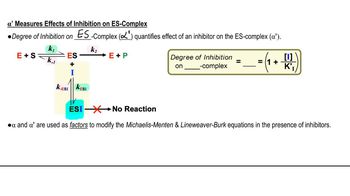
    It is called alpha prime (α'), represented with a prime symbol.
  • How is alpha prime (α') calculated?

    Alpha prime is calculated as 1 plus the ratio of the concentration of inhibitor to the inhibition constant for the enzyme-substrate complex: α' = 1 + [I]/K'_I.
  • What complex forms when an inhibitor binds to the enzyme-substrate complex?

    The E-S-I complex forms when an inhibitor binds to the enzyme-substrate complex.
  • What happens to the reaction when the inhibitor is bound to the enzyme or enzyme-substrate complex?

    No reaction is able to take place when the inhibitor is bound to the enzyme or enzyme-substrate complex.
  • Are alpha and alpha prime unitless, and why?

    Yes, both alpha and alpha prime are unitless because they are ratios of concentrations.
  • How do alpha and alpha prime affect enzyme kinetics equations?

    Alpha and alpha prime modify the Michaelis-Menten and Lineweaver-Burk equations in the presence of inhibitors.
  • Why do biochemists measure both alpha and alpha prime?

    Biochemists measure both to separately quantify the degree of inhibition on the free enzyme and the enzyme-substrate complex.