Back

Degree of Inhibition definitions

Control buttons has been changed to "navigation" mode.
1/14
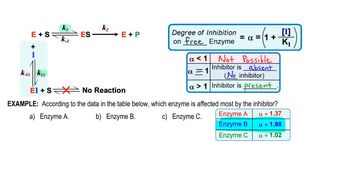
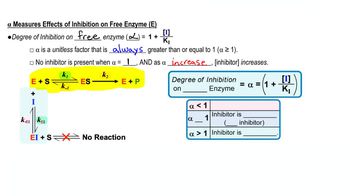
  • Degree of Inhibition

    Factor quantifying how much an enzyme's activity is reduced by an inhibitor, affecting the initial reaction velocity.
  • Enzyme

    Protein catalyst that accelerates biochemical reactions, susceptible to inhibition by specific molecules.
  • Inhibitor

    Molecule that binds to an enzyme or enzyme-substrate complex, decreasing the reaction rate.
  • Initial Reaction Velocity

    Rate at which an enzyme-catalyzed reaction proceeds at the start, before significant substrate depletion.
  • E-I Complex

    Structure formed when an inhibitor binds to the free enzyme, preventing substrate interaction.
  • E-S-I Complex

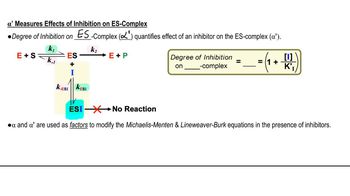
    Structure resulting from inhibitor binding to the enzyme-substrate complex, halting the reaction.
  • Alpha

    Unitless variable representing inhibition degree on the free enzyme, calculated as 1 plus inhibitor concentration over inhibition constant.
  • Alpha Prime

    Unitless variable quantifying inhibition degree on the enzyme-substrate complex, using a specific inhibition constant.
  • Inhibition Constant

    Concentration of inhibitor required to achieve half-maximal inhibition of an enzyme or enzyme-substrate complex.
  • Michaelis-Menten Equation

    Mathematical model describing enzyme kinetics, modified by inhibition factors in the presence of inhibitors.
  • Lineweaver-Burk Equation

    Linearized form of enzyme kinetics equation, adjusted by inhibition degree variables when inhibitors are present.
  • Free Enzyme

    Unbound enzyme available for substrate interaction, target for certain inhibitors.
  • Enzyme-Substrate Complex

    Intermediate formed when an enzyme binds its substrate, susceptible to inhibition by specific molecules.
  • Concentration of Inhibitor

    Amount of inhibitory molecule present, directly influencing the degree of enzyme inhibition.