Back

Chymotrypsin's Catalytic Mechanism quiz

Control buttons has been changed to "navigation" mode.
1/15
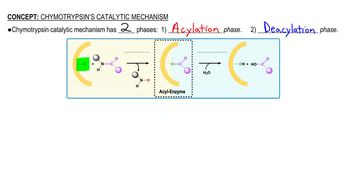
  • What are the two main phases of chymotrypsin's catalytic mechanism?

    The two main phases are the acylation phase and the deacylation phase.
  • Which amino acids make up the catalytic triad in chymotrypsin's active site?

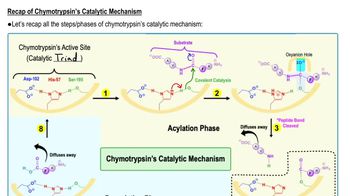
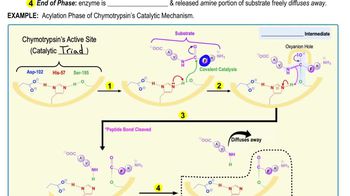
    The catalytic triad consists of aspartate 102, histidine 57, and serine 195.
  • What is the role of serine 195 during the acylation phase?

    Serine 195 acts as a nucleophile, attacking the carbonyl carbon of the substrate to form a covalent ester linkage.
  • How does the oxyanion hole contribute to chymotrypsin's mechanism?

    The oxyanion hole stabilizes the unstable tetrahedral intermediate formed during both acylation and deacylation.
  • What type of catalysis is exemplified by the formation of a covalent ester linkage in chymotrypsin?

    This is an example of covalent catalysis.
  • During which phase is the peptide bond of the substrate cleaved?

    The peptide bond is cleaved during the acylation phase.
  • What happens to the enzyme at the end of the acylation phase?

    The enzyme becomes acylated, forming a covalent acyl-enzyme intermediate.
  • What is the nucleophile in the deacylation phase of chymotrypsin's mechanism?

    Water acts as the nucleophile in the deacylation phase.
  • What is the main purpose of the deacylation phase?

    The deacylation phase hydrolyzes the ester bond to regenerate the original enzyme and release the carboxylic acid product.
  • What role does histidine 57 play during the nucleophilic attack steps?

    Histidine 57 acts as a base, accepting a proton to activate the nucleophile (serine or water).
  • What is the leaving group during the acylation phase?

    The amine portion of the substrate is the leaving group during acylation.
  • What is the leaving group during the deacylation phase?

    The carboxylic acid portion of the substrate is the leaving group during deacylation.
  • How does chymotrypsin achieve substrate specificity?

    Chymotrypsin recognizes and cleaves peptide bonds adjacent to aromatic amino acid residues.
  • What is the sequence of general steps in both the acylation and deacylation phases?

    The steps are substrate binding, nucleophilic attack, removal of the leaving group, and end of the phase.
  • What is regenerated at the end of the deacylation phase?

    The original, unmodified chymotrypsin enzyme is regenerated, ready for another catalytic cycle.