Back

Chymotrypsin's Catalytic Mechanism definitions

Control buttons has been changed to "navigation" mode.
1/15
  • Chymotrypsin

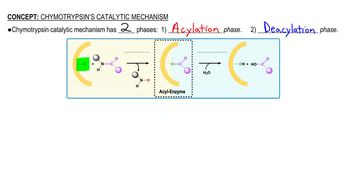
    A protease that selectively cleaves peptide bonds at the C-terminal of aromatic amino acids using a two-phase catalytic mechanism.
  • Catalytic Triad

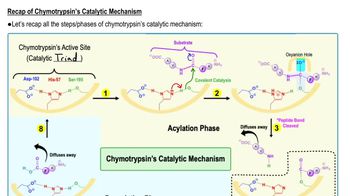
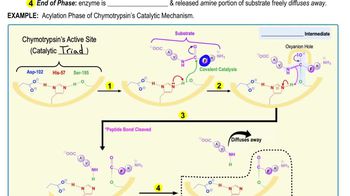
    A group of three amino acids—Aspartate 102, Histidine 57, Serine 195—essential for activating serine as a nucleophile in the enzyme's active site.
  • Acylation

    The initial phase where a covalent ester linkage forms between the enzyme and substrate, resulting in peptide bond cleavage.
  • Deacylation

    The second phase where water hydrolyzes the ester bond, releasing the carboxylic acid and regenerating the enzyme.
  • Serine 195

    An amino acid residue in the active site, activated by the catalytic triad to perform nucleophilic attacks during catalysis.
  • Histidine 57

    A residue in the catalytic triad that acts as both a base and acid, facilitating proton transfers and nucleophile activation.
  • Aspartate 102

    A residue in the catalytic triad that stabilizes histidine, enhancing its ability to activate serine for nucleophilic attack.
  • Oxyanion Hole

    A region in the enzyme's active site that stabilizes the negative charge of the tetrahedral intermediate during catalysis.
  • Tetrahedral Intermediate

    A transient, unstable structure formed during nucleophilic attack, stabilized by the oxyanion hole before bond cleavage.
  • Ester Linkage

    A temporary covalent bond formed between serine and the substrate during acylation, later hydrolyzed in deacylation.
  • Acyl Enzyme

    A covalently modified enzyme formed after acylation, with the substrate attached via an ester linkage.
  • Peptide Bond

    A chemical bond between amino acids in proteins, specifically targeted and cleaved by chymotrypsin.
  • Aromatic Amino Acid

    A type of amino acid, such as phenylalanine, recognized by chymotrypsin for selective peptide bond cleavage.
  • Covalent Catalysis

    A mechanism where the enzyme forms a temporary covalent bond with the substrate to facilitate bond cleavage.
  • Active Site

    The region of chymotrypsin containing the catalytic triad, where substrate binding and catalysis occur.