Back

Chemical Cleavage of Bonds quiz

Control buttons has been changed to "navigation" mode.
1/15
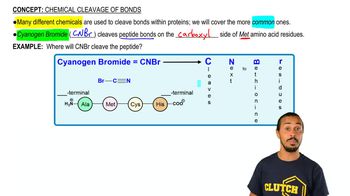
  • What specific peptide bond does cyanogen bromide (CNBr) cleave in proteins?

    Cyanogen bromide cleaves peptide bonds on the carboxyl side of methionine residues.
  • How can you remember where cyanogen bromide cleaves a peptide?

    Rotating the 'B' in CNBr 90 degrees counterclockwise makes it look like an 'M', reminding you it cleaves next to methionine.
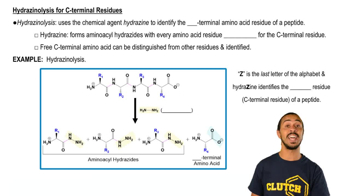
  • What is the purpose of hydrazine in hydrazinolysis?

    Hydrazine is used to identify the C-terminal amino acid residue of a peptide.
  • What distinguishes the C-terminal residue after hydrazine treatment?

    The C-terminal residue does not form an aminoacylhydrazide, making it chemically different and easily identifiable.
  • Why is hydrazine associated with identifying the last residue of a peptide?

    Hydrazine contains a 'z', the last letter of the alphabet, helping you remember it identifies the last (C-terminal) residue.
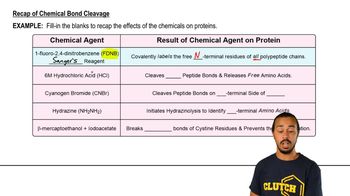
  • What bond does beta mercaptoethanol specifically break in proteins?

    Beta mercaptoethanol breaks disulfide bonds between cysteine residues.
  • Why is iodoacetate used after beta mercaptoethanol in protein sequencing?

    Iodoacetate carboxymethylates cysteine sulfhydryl groups, preventing the reformation of disulfide bonds.
  • What is the effect of using both beta mercaptoethanol and iodoacetate together?

    Together, they permanently break disulfide bonds, allowing protein sequencing without interference.
  • What is the function of 1-fluoro-2,4-dinitrobenzene (FDNB or Sanger's reagent) in protein analysis?

    FDNB covalently labels the N-terminal amino acid residues of polypeptides without cleaving any bonds.
  • What information can be obtained by using FDNB with 6 molar hydrochloric acid?

    This combination reveals the N-terminal residues and the number of subunits in a protein.
  • What does 6 molar hydrochloric acid do to proteins?

    It induces complete amino acid hydrolysis, cleaving all peptide bonds and releasing all amino acids as free molecules.
  • How can the amino acid composition of a protein be determined after hydrolysis with 6 molar HCl?

    Techniques like HPLC or mass spectrometry are used to analyze the free amino acids released.
  • Why must disulfide bonds be broken before Edman degradation sequencing?

    Disulfide bonds interfere with the sequencing procedure, so they must be broken to allow accurate sequencing.
  • What happens to cysteine residues after treatment with iodoacetate?

    Their sulfhydryl groups are carboxymethylated, preventing disulfide bond reformation.
  • Which reagent is unique in labeling but not cleaving protein bonds, and what does it label?

    FDNB (Sanger's reagent) is unique in labeling the N-terminal amino acid residues without cleaving any bonds.