Back

Chemical Cleavage of Bonds definitions

Control buttons has been changed to "navigation" mode.
1/15
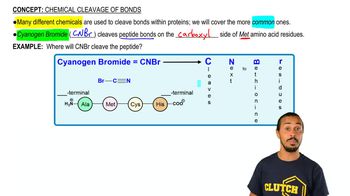
  • Cyanogen Bromide

    A reagent that cleaves peptide bonds specifically on the carboxyl side of methionine residues, splitting proteins for sequence analysis.
  • Methionine

    An amino acid residue targeted by cyanogen bromide for selective peptide bond cleavage during protein fragmentation.
  • Peptide Bond

    A covalent linkage between amino acid residues in proteins, susceptible to cleavage by specific chemical agents.
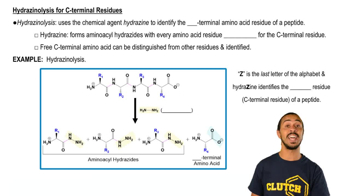
  • Hydrazine

    A chemical used in hydrazinolysis to distinguish and identify the C-terminal amino acid residue by forming aminoacylhydrazides.
  • Hydrazinolysis

    A process where hydrazine reacts with peptide residues, except the C-terminal, enabling identification of the terminal amino acid.
  • C-Terminal Residue

    The last amino acid in a peptide chain, uniquely unmodified in hydrazinolysis, allowing for its identification.
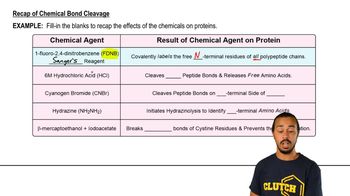
  • Beta Mercaptoethanol

    A reducing agent that breaks disulfide bonds in proteins, facilitating their separation for sequencing.
  • Disulfide Bond

    A covalent connection between two cysteine residues, often requiring reduction for protein sequencing.
  • Iodoacetate

    A reagent that carboxymethylates cysteine sulfhydryl groups, preventing reformation of disulfide bonds after reduction.
  • Carboxymethylation

    A modification of cysteine sulfhydryl groups by iodoacetate, ensuring disulfide bonds remain broken during analysis.
  • Sanger's Reagent

    A compound, also known as FDNB, used to label N-terminal amino acid residues without cleaving peptide bonds.
  • N-Terminal Residue

    The first amino acid in a polypeptide chain, identifiable by covalent labeling with Sanger's reagent.
  • 6 Molar Hydrochloric Acid

    A strong acid used for complete hydrolysis of proteins, releasing all amino acids for compositional analysis.
  • Aminoacylhydrazide

    A product formed when hydrazine reacts with peptide residues, except the C-terminal, aiding in terminal residue identification.
  • Amino Acid Composition

    The profile of amino acids in a protein, determined after hydrolysis and analysis by techniques like HPLC or mass spectrometry.