Back

BPG Regulation of Hemoglobin quiz

Control buttons has been changed to "navigation" mode.
1/15
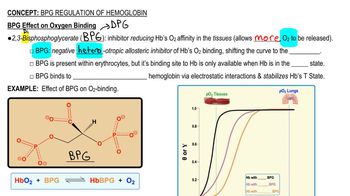
  • What does BPG stand for and what is its structural feature?

    BPG stands for 2,3-bisphosphoglycerate and it contains two phosphate groups.
  • What is the main effect of BPG on hemoglobin's oxygen affinity?

    BPG acts as an allosteric inhibitor, reducing hemoglobin's oxygen affinity and promoting oxygen release in tissues.
  • To which state of hemoglobin does BPG bind, and what is the result?

    BPG binds to the T (tense) state of hemoglobin, stabilizing it and promoting oxygen release.
  • How does BPG binding compare to the effects of carbon dioxide and protons on hemoglobin?

    BPG has a similar effect as carbon dioxide and protons, all acting as negative heterotrophic allosteric inhibitors that shift the oxygen binding curve to the right.
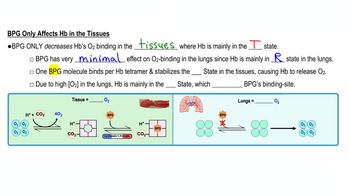
  • In which part of the body does BPG primarily affect hemoglobin, and why?

    BPG primarily affects hemoglobin in the tissues because hemoglobin is mainly in the T state there, which allows BPG binding.
  • Why does BPG have minimal effect on hemoglobin in the lungs?

    In the lungs, hemoglobin is mostly in the R (relaxed) state, which does not have a binding site for BPG, so BPG cannot bind and has little effect.
  • How many BPG molecules bind to a hemoglobin tetramer?

    One BPG molecule binds per hemoglobin tetramer, not per subunit.
  • What type of interaction allows BPG to bind to hemoglobin?

    BPG binds to hemoglobin via electrostatic, non-covalent interactions.
  • What is the normal concentration of BPG in erythrocytes at sea level?

    The normal BPG concentration in erythrocytes at sea level is about 5 millimolar.
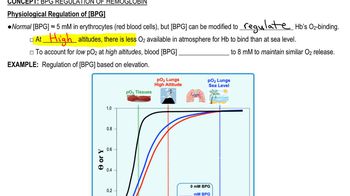
  • How does BPG concentration change at high altitudes and why?

    At high altitudes, BPG concentration increases to about 8 millimolar to help maintain oxygen release despite lower atmospheric oxygen.
  • What happens to the hemoglobin oxygen binding curve as BPG concentration increases?

    Increasing BPG concentration shifts the hemoglobin oxygen binding curve to the right, indicating increased oxygen release.
  • How do individuals with anemia compensate for reduced hemoglobin levels?

    Individuals with anemia often have elevated BPG levels to enhance oxygen release and compensate for reduced oxygen transport capacity.
  • Why do athletes train at high altitudes in relation to BPG?

    Athletes train at high altitudes to acclimate their bodies to higher BPG concentrations, which enhances oxygen release when they return to lower altitudes.
  • What is the effect of BPG binding on the equilibrium of oxygen release in tissues?

    BPG binding shifts the equilibrium further to the right, leading to increased oxygen release from hemoglobin in tissues.
  • What is the difference between the 'bi' and 'di' prefixes in BPG/DPG nomenclature?

    Both 'bi' and 'di' mean two, so BPG and DPG refer to the same molecule; the difference is only in the prefix used.