Back

BPG Regulation of Hemoglobin definitions

Control buttons has been changed to "navigation" mode.
1/15
  • BPG

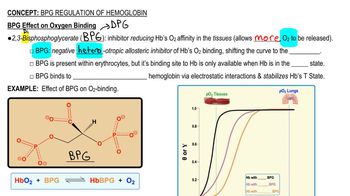
    A molecule with two phosphate groups that binds to deoxygenated hemoglobin, reducing oxygen affinity and promoting oxygen release in tissues.
  • Hemoglobin

    A tetrameric protein in erythrocytes responsible for oxygen transport, with oxygen affinity regulated by allosteric effectors like BPG.
  • T State

    A tense conformation of hemoglobin with low oxygen affinity, stabilized by BPG, carbon dioxide, and protons.
  • R State

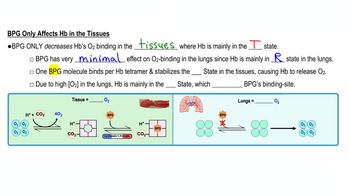
    A relaxed conformation of hemoglobin with high oxygen affinity, predominant in the lungs and unable to bind BPG.
  • Allosteric Inhibitor

    A molecule that binds to a protein at a site other than the active site, decreasing its activity, such as BPG with hemoglobin.
  • Oxygen Affinity

    The tendency of hemoglobin to bind oxygen, which decreases in the presence of BPG, facilitating oxygen release.
  • Erythrocyte

    A red blood cell containing hemoglobin and BPG, crucial for oxygen transport and regulation.
  • Carbon Dioxide

    A molecule that, along with protons and BPG, promotes hemoglobin's transition to the t state, enhancing oxygen release.
  • Proton

    A positively charged particle that increases in tissues, contributing to hemoglobin's t state stabilization and oxygen release.
  • Oxygen Saturation Curve

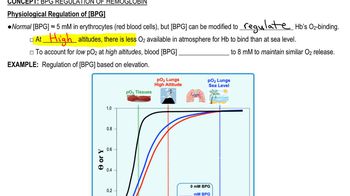
    A graphical representation of hemoglobin's oxygen binding, shifted right by increased BPG, indicating enhanced oxygen release.
  • Partial Pressure

    A measure of oxygen concentration in tissues or lungs, influencing hemoglobin's state and BPG's effect.
  • Anemia

    A condition with reduced red blood cell count and hemoglobin, often compensated by elevated BPG to maintain oxygen delivery.
  • Altitude

    A factor affecting atmospheric oxygen levels, leading to increased BPG concentrations for efficient oxygen release.
  • Tetramer

    A protein structure composed of four subunits, as seen in hemoglobin, with one BPG binding site per molecule.
  • Electrostatic Interaction

    A non-covalent force enabling BPG to bind deoxygenated hemoglobin, stabilizing the t state without permanent attachment.