Back

The Power of a Quotient Rule quiz

Control buttons has been changed to "navigation" mode.
1/15
  • What does the power of a quotient rule allow you to do with an exponent applied to a fraction?

    It allows you to distribute the exponent to both the numerator and denominator of the fraction.
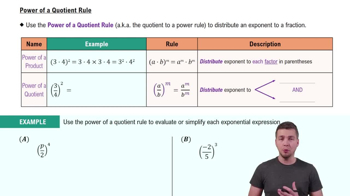
  • How do you simplify (p/2)^4 using the power of a quotient rule?

    You write it as p^4/2^4, then simplify 2^4 to get p^4/16.
  • What is the result of (-2/5)^3 after applying the power of a quotient rule?

    It becomes (-2)^3/5^3, which simplifies to -8/125.
  • Why is it important to keep parentheses around negative numbers when applying the power of a quotient rule?

    Parentheses ensure the exponent is applied to the entire negative number, not just the positive part.
  • What happens to the sign of a negative base when it is raised to an odd exponent?

    The result remains negative because an odd number of negatives results in a negative product.
  • What is the general notation for the power of a quotient rule?

    If (a/b)^n, it equals a^n/b^n.
  • Can the power of a quotient rule be referred to by another name?

    Yes, it is sometimes called the quotient to a power rule.
  • What should you do after distributing the exponent to both numerator and denominator?

    You should simplify the resulting expressions if possible.
  • If a fraction contains variables and numbers, which parts can usually be simplified after applying the rule?

    Numerical parts can often be simplified, while variables raised to exponents usually remain as is.
  • What is the result of (3/4)^2 using the power of a quotient rule?

    It becomes 3^2/4^2, which simplifies to 9/16.
  • How do you multiply fractions when applying the power of a quotient rule?

    Multiply the numerators together and the denominators together.
  • What is the result of (a/b)^n according to the power of a quotient rule?

    It is a^n divided by b^n.
  • What should you check for when simplifying fractions with exponents?

    Check if the numerator or denominator can be further simplified or evaluated.
  • What is the result of (x/3)^2 using the power of a quotient rule?

    It becomes x^2/3^2, which simplifies to x^2/9.
  • What is the result of (5/2)^3 using the power of a quotient rule?

    It becomes 5^3/2^3, which simplifies to 125/8.