Back

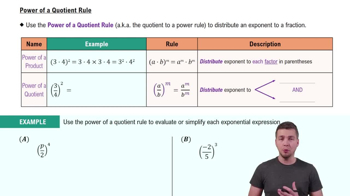
The Power of a Quotient Rule definitions

Control buttons has been changed to "navigation" mode.
1/15
  • Exponent

    A number indicating how many times a base is multiplied by itself, applied to both numerator and denominator in the rule.
  • Numerator

    The top part of a fraction, receiving the distributed exponent when applying the rule.
  • Denominator

    The bottom part of a fraction, also receiving the distributed exponent in the rule.
  • Fraction

    A mathematical expression representing a quotient, where the rule distributes exponents to both parts.
  • Quotient

    A result of division, often written as a fraction, which can be raised to a power and simplified using the rule.
  • Variable

    A symbol, such as p, that can be raised to an exponent and appears in the numerator or denominator.
  • Coefficient

    A numerical factor in a term, which can be raised to a power and simplified when applying the rule.
  • Parenthesis

    A grouping symbol used to clarify which terms an exponent applies to, especially with negative bases.
  • Negative Base

    A value less than zero inside a fraction, requiring careful use of parentheses when raised to a power.
  • Product

    A result of multiplication, related to the power of a product rule, which distributes exponents to each factor.
  • Simplification

    The process of reducing an expression to its most basic form after distributing exponents and evaluating powers.
  • Monomial

    An algebraic expression with a single term, often appearing in fractions raised to a power.
  • Polynomial

    An expression with multiple terms, which may involve fractions and exponents requiring the rule for simplification.
  • Power

    The result of raising a base to an exponent, distributed to both parts of a fraction in the rule.
  • Notation

    A symbolic way to represent mathematical rules, such as showing how exponents are distributed in fractions.