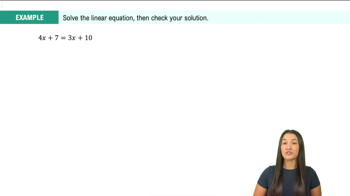
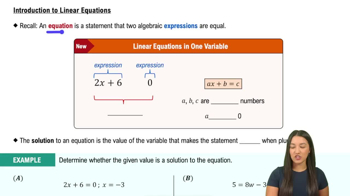
What is a linear equation and how is it generally written?
A linear equation is an equation where the variable has a degree of one and is generally written as ax + b = c, where a, b, and c are real numbers and a ≠ 0.
What does it mean for a value to be a solution to a linear equation?
A solution is a value for the variable that makes the equation true when substituted into the equation.
How can you verify if a given value is a solution to a linear equation?
Substitute the value into the equation for the variable and check if both sides of the equation are equal.
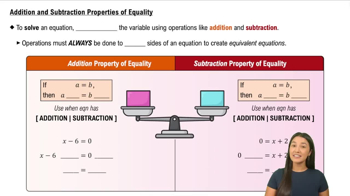
What is the addition property of equality?
The addition property of equality states that if a = b, then a + c = b + c for any real number c.
When should you use the addition property of equality when solving equations?
Use the addition property when the equation involves subtraction, to cancel out the subtraction and isolate the variable.
What is the subtraction property of equality?
The subtraction property of equality states that if a = b, then a - c = b - c for any real number c.
When should you use the subtraction property of equality when solving equations?
Use the subtraction property when the equation involves addition, to cancel out the addition and isolate the variable.
Why must you perform the same operation on both sides of an equation?
To maintain the balance and equality of the equation, ensuring both sides remain equal.
What is meant by 'isolating the variable' in an equation?
Isolating the variable means rearranging the equation so the variable is alone on one side of the equation.
How do you write the solution set for a linear equation?
Place the solution inside curly brackets, for example, {6} if x = 6 is the solution.
If you solve an equation and get x = 5, how can you check your answer?
Substitute x = 5 back into the original equation and verify that both sides are equal.
What does it mean if substituting a value into an equation does not make both sides equal?
It means that the value is not a solution to the equation.
Can a linear equation have a variable other than x? Give an example.
Yes, any letter can be used as the variable, such as w in the equation 8w - 3 = 5.
What is the standard form of a linear equation?
The standard form is ax + b = c, where a, b, and c are real numbers and a ≠ 0.
What is the purpose of using properties of equality when solving equations?
They allow you to create equivalent equations and systematically isolate the variable to find the solution.