Back

The Addition and Subtraction Properties of Equality definitions

Control buttons has been changed to "navigation" mode.
1/15
  • Linear Equation

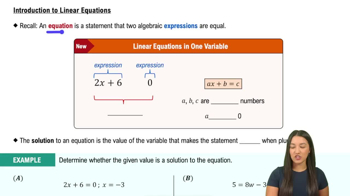
    A mathematical statement with a variable raised only to the first power, often written as ax + b = c.
  • Variable

    A symbol, often a letter, representing an unknown value that can change within an equation.
  • Coefficient

    A numerical factor multiplied by a variable in an algebraic expression.
  • Constant

    A fixed value in an equation that does not change or contain variables.
  • Solution

    A value for the variable that makes an equation a true statement when substituted.
  • Solution Set

    A collection of all values that satisfy a given equation, typically shown in curly brackets.
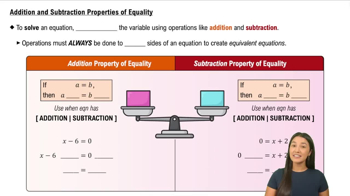
  • Addition Property of Equality

    A rule stating that adding the same value to both sides of an equation keeps the equation balanced.
  • Subtraction Property of Equality

    A rule stating that subtracting the same value from both sides of an equation keeps the equation balanced.
  • Equivalent Equations

    Different equations that have the same solution or solution set.
  • First Degree Polynomial

    An algebraic expression where the highest exponent of the variable is one.
  • Expression

    A combination of numbers, variables, and operations without an equal sign.
  • Balance Scale

    A visual analogy used to illustrate that both sides of an equation must remain equal after operations.
  • Standard Form

    A way of writing equations where terms are ordered, typically as ax + b = c for linear equations.
  • Opposite Operations

    Operations that reverse each other's effects, such as addition and subtraction, used to isolate variables.
  • Verification

    The process of checking a proposed solution by substituting it back into the original equation.