Ch. 3 The Cellular Level of Organization
Martini - Fundamentals of Anatomy and Physiology 12th Edition
Martini, Nath, Bartholomew12th EditionFundamentals of Anatomy and PhysiologyISBN: 9780137854011Not the one you use?Change textbook
Chapter 3, Problem 9

The movement of water across a membrane from an area of low solute concentration to an area of higher solute concentration is known as
(a) Osmosis
(b) Active transport
(c) Diffusion
(d) Facilitated transport
(e) Filtration

Verified step by step guidance
1
Step 1: Understand the key terms related to membrane transport. Water movement across a membrane is often driven by differences in solute concentration on either side of the membrane.
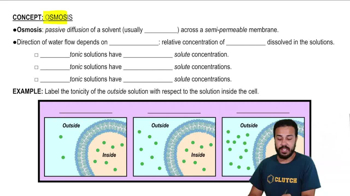
Step 2: Recall that osmosis specifically refers to the movement of water molecules through a selectively permeable membrane from an area of low solute concentration to an area of higher solute concentration.
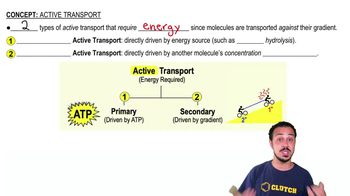
Step 3: Differentiate osmosis from other transport mechanisms: Active transport requires energy and moves substances against their concentration gradient; diffusion is the movement of solutes from high to low concentration; facilitated transport involves carrier proteins but does not specifically describe water movement; filtration is driven by pressure differences.
Step 4: Identify that the correct term describing water movement from low to high solute concentration is osmosis.
Step 5: Conclude that the answer to the question is (a) Osmosis, based on the definition and characteristics of water movement across membranes.

Verified video answer for a similar problem:

This video solution was recommended by our tutors as helpful for the problem above.
Video duration:
2m
Was this helpful?

Key Concepts

Here are the essential concepts you must grasp in order to answer the question correctly.

Osmosis

Osmosis is the passive movement of water molecules across a selectively permeable membrane from a region of low solute concentration to a region of high solute concentration. This process aims to equalize solute concentrations on both sides of the membrane without requiring energy.
Recommended video:
05:59
Osmosis

Active Transport

Active transport is the energy-dependent movement of molecules or ions across a membrane against their concentration gradient. It requires cellular energy (ATP) and specific transport proteins to move substances from low to high concentration.
Recommended video:
02:37
Active Transport

Diffusion

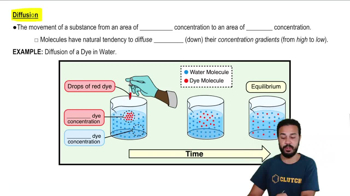
Diffusion is the passive movement of molecules from an area of higher concentration to an area of lower concentration until equilibrium is reached. Unlike osmosis, diffusion involves solutes rather than water and does not require a membrane.
Recommended video:
02:44
Diffusion