Ch. 3 The Cellular Level of Organization
Martini - Fundamentals of Anatomy and Physiology 12th Edition
Martini, Nath, Bartholomew12th EditionFundamentals of Anatomy and PhysiologyISBN: 9780137854011Not the one you use?Change textbook
Chapter 3, Problem 5

At resting membrane potential, the cytoplasmic side of the membrane surface of the cell is___, and the cell extracellular membrane surface is___.
(a) slightly negative; slightly positive
(b) slightly positive; slightly negative
(c) slightly positive; neutral
(d) slightly negative; neutral

Verified step by step guidance
1
Understand that the resting membrane potential refers to the voltage difference across the cell membrane when the cell is at rest, meaning it is not actively sending signals.
Recall that the resting membrane potential is typically negative inside the cell relative to the outside, due to the distribution of ions such as potassium (K+) and sodium (Na+).
Recognize that the cytoplasmic side (inside) of the membrane is more negatively charged because of the higher concentration of negatively charged proteins and ions inside the cell.
Understand that the extracellular side (outside) of the membrane is relatively more positive compared to the inside, due to the higher concentration of positively charged ions like sodium (Na+).
Based on this, conclude that at resting membrane potential, the cytoplasmic side is slightly negative, and the extracellular side is slightly positive, which corresponds to option (a).

Verified video answer for a similar problem:

This video solution was recommended by our tutors as helpful for the problem above.
Video duration:
3m
Was this helpful?

Key Concepts

Here are the essential concepts you must grasp in order to answer the question correctly.

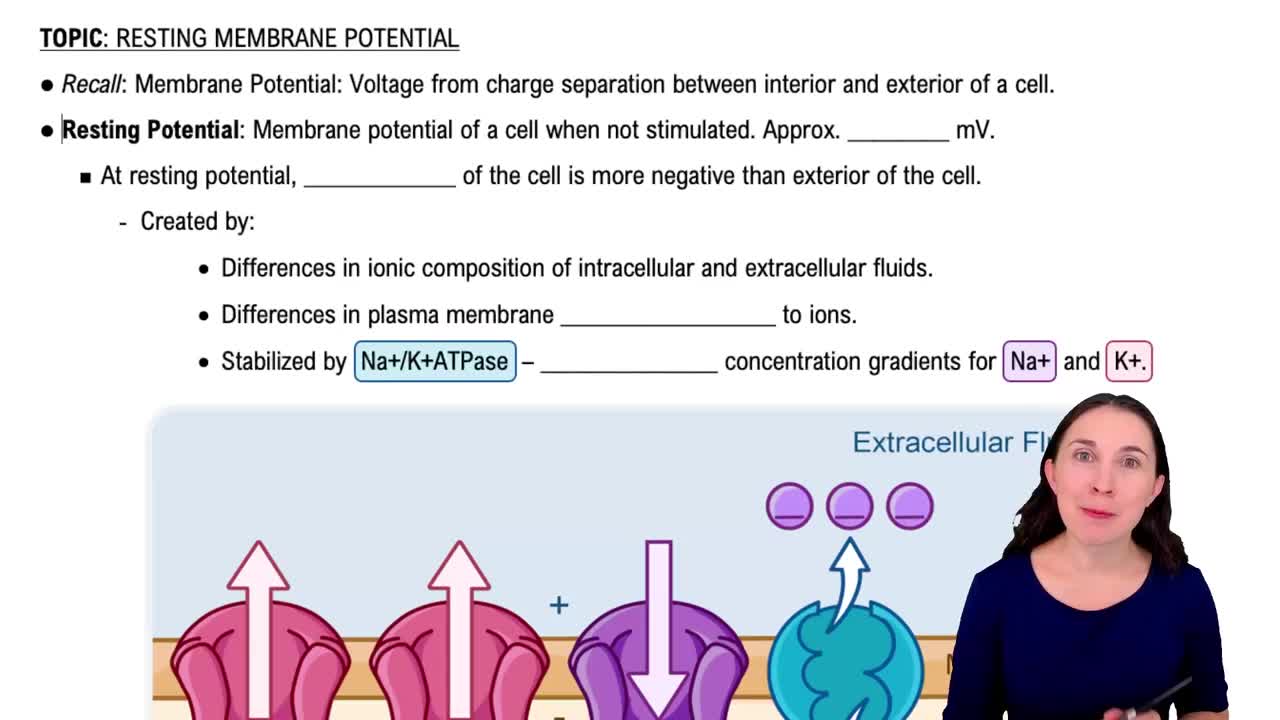
Resting Membrane Potential

The resting membrane potential is the voltage difference across a cell's plasma membrane when the cell is at rest. It typically ranges from -60 to -70 mV in many cells, indicating the inside of the cell is negatively charged relative to the outside. This potential is essential for processes like nerve impulse transmission and muscle contraction.
Recommended video:
07:53
Resting Membrane Potential

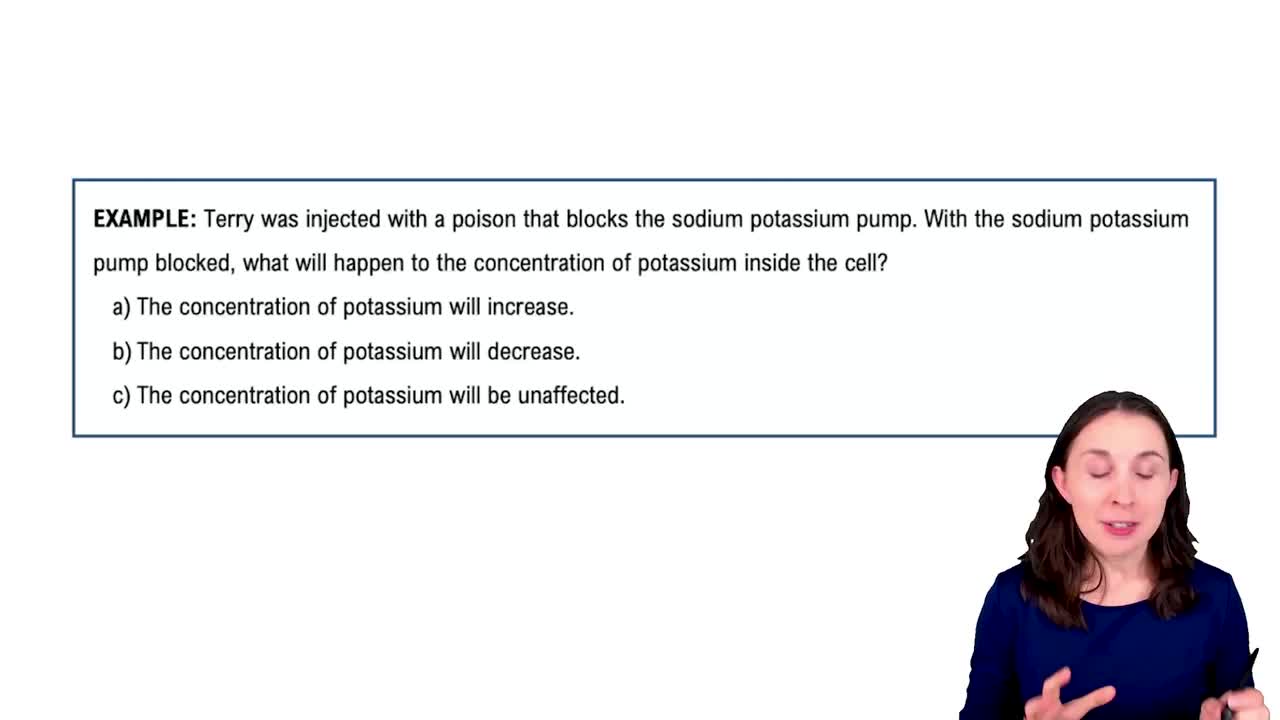
Ion Distribution and Membrane Permeability

The resting membrane potential arises mainly due to the unequal distribution of ions, especially potassium (K+), sodium (Na+), and chloride (Cl-), across the membrane. The membrane is more permeable to K+, allowing it to leak out, making the inside more negative compared to the outside, which remains relatively positive.
Recommended video:
01:55
Ions - Sodium and Potassium Example 3

Charge Separation Across the Membrane

At rest, the cytoplasmic side of the membrane is slightly negative due to trapped anions and ion gradients, while the extracellular side is slightly positive. This charge separation creates an electrical potential difference, crucial for cellular excitability and signaling.
Recommended video:
07:10
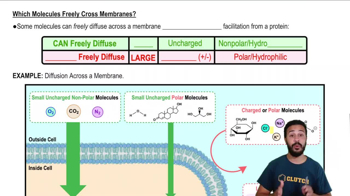
Which Molecules Freely Cross Membranes?