Ch. 29 Development and Inheritance
Martini - Fundamentals of Anatomy and Physiology 12th Edition
Martini, Nath, Bartholomew12th EditionFundamentals of Anatomy and PhysiologyISBN: 9780137854011Not the one you use?Change textbook
Chapter 28, Problem 24a

Indicate the type of inheritance involved in each of the following situations. 
(a) Children who exhibit the trait have at least one parent who also exhibits it. 

Verified step by step guidance
1
Understand the concept of inheritance patterns in genetics, which describe how traits are passed from parents to offspring.
Analyze the statement: 'Children who exhibit the trait have at least one parent who also exhibits it.' This suggests that the trait does not skip generations.
Recall that in dominant inheritance, an affected individual usually has at least one affected parent because only one copy of the dominant allele is needed to express the trait.
Contrast this with recessive inheritance, where children can exhibit the trait even if neither parent shows it, due to carriers.
Conclude that the described pattern corresponds to a dominant mode of inheritance, where the trait appears in every generation and affected children have affected parents.

Verified video answer for a similar problem:

This video solution was recommended by our tutors as helpful for the problem above.
Was this helpful?

Key Concepts

Here are the essential concepts you must grasp in order to answer the question correctly.

Types of Inheritance Patterns

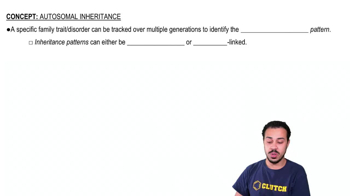
Inheritance patterns describe how traits are passed from parents to offspring. Common types include dominant, recessive, autosomal, and sex-linked inheritance. Understanding these patterns helps determine how a trait is transmitted through generations.
Recommended video:
01:02
Autosomal Inheritance

Dominant Inheritance

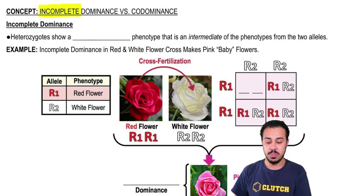
In dominant inheritance, only one copy of a dominant allele is needed for the trait to be expressed. Affected individuals usually have at least one affected parent, as the trait does not skip generations.
Recommended video:
03:09
Incomplete Dominance

Recessive Inheritance

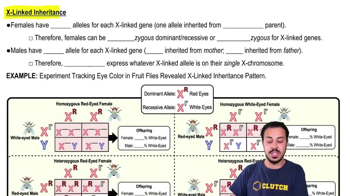
Recessive inheritance requires two copies of a recessive allele for the trait to be expressed. Traits can skip generations, and affected children may have parents who do not show the trait but are carriers.
Recommended video:
07:23
X-Linked Inheritance