Ch. 26 The Urinary System
Martini - Fundamentals of Anatomy and Physiology 12th Edition
Martini, Nath, Bartholomew12th EditionFundamentals of Anatomy and PhysiologyISBN: 9780137854011Not the one you use?Change textbook
Chapter 25, Problem 31

The drug Diamox is sometimes used to treat mountain sickness. Diamox inhibits the action of carbonic anhydrase in the proximal convoluted tubule. Polyuria (excessive urine production resulting in frequent urination) is a side effect associated with the medication. Why does polyuria occur?

Verified step by step guidance
1
Step 1: Understand the role of carbonic anhydrase in the proximal convoluted tubule (PCT). Carbonic anhydrase catalyzes the reversible reaction converting carbon dioxide and water into carbonic acid, which dissociates into hydrogen ions (H\_+) and bicarbonate ions (HCO\_3\^-). This reaction is crucial for reabsorbing bicarbonate and sodium ions in the PCT.
Step 2: Recognize that inhibition of carbonic anhydrase by Diamox reduces the formation of hydrogen ions in the tubular cells. Since hydrogen ions are needed for the sodium-hydrogen exchanger to function, less sodium is reabsorbed from the tubular fluid back into the blood.
Step 3: Understand that decreased sodium reabsorption leads to increased sodium remaining in the tubular fluid. Sodium in the tubule lumen holds water by osmosis, so more sodium in the tubule means more water stays in the urine.
Step 4: Connect the increased sodium and water remaining in the tubular fluid to increased urine volume, which is called polyuria. This explains why Diamox causes excessive urine production.
Step 5: Summarize that the inhibition of carbonic anhydrase disrupts normal sodium and bicarbonate reabsorption, leading to osmotic diuresis and polyuria as a side effect of the medication.

Verified video answer for a similar problem:

This video solution was recommended by our tutors as helpful for the problem above.
Was this helpful?

Key Concepts

Here are the essential concepts you must grasp in order to answer the question correctly.

Role of Carbonic Anhydrase in the Proximal Convoluted Tubule

Carbonic anhydrase is an enzyme that facilitates the conversion of carbon dioxide and water into bicarbonate and hydrogen ions. In the proximal convoluted tubule, this reaction is crucial for reabsorbing bicarbonate and sodium, which helps maintain acid-base balance and fluid reabsorption.
Recommended video:
6:51
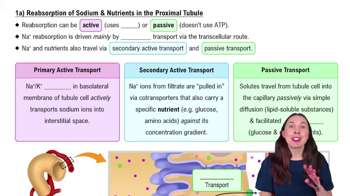
1a) Reabsorption of Sodium & Nutrients in the Proximal Tubule

Mechanism of Action of Diamox (Acetazolamide)

Diamox inhibits carbonic anhydrase, reducing bicarbonate reabsorption in the proximal tubule. This leads to increased bicarbonate, sodium, and water remaining in the tubular fluid, which increases urine volume and causes diuresis.
Recommended video:
03:53
Action Potential

Cause of Polyuria Due to Impaired Reabsorption

When bicarbonate and sodium reabsorption is blocked, more solutes stay in the urine, increasing its osmolarity. This osmotic effect prevents water reabsorption, resulting in excessive urine production or polyuria as the kidneys excrete more fluid.
Recommended video:
2:30
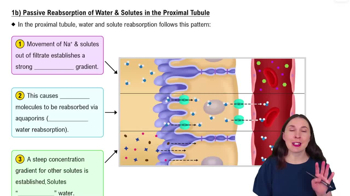
1b) Passive Reabsorption of Water & Solutes in the Proximal Tubule