Ch. 24 The Digestive System
Martini - Fundamentals of Anatomy and Physiology 12th Edition
Martini, Nath, Bartholomew12th EditionFundamentals of Anatomy and PhysiologyISBN: 9780137854011Not the one you use?Change textbook
Chapter 24, Problem 4

A branch of the hepatic portal vein, hepatic artery proper, and branch of the bile duct form\(a) A liver lobule
(b) The sinusoids
(c) A portal triad
(d) The hepatic duct
(e) The pancreatic duct

Verified step by step guidance
1
Step 1: Understand the components mentioned in the problem: a branch of the hepatic portal vein, hepatic artery proper, and a branch of the bile duct. These three structures are anatomically grouped together in the liver.
Step 2: Recall the anatomical term for the grouping of these three structures. In liver histology, the combination of a branch of the hepatic portal vein, a branch of the hepatic artery, and a bile duct branch is known as the 'portal triad.'
Step 3: Differentiate the portal triad from other liver structures: the liver lobule is the functional unit of the liver, sinusoids are capillary-like vessels within the lobule, the hepatic duct carries bile out of the liver, and the pancreatic duct is unrelated to liver anatomy.
Step 4: Conclude that the correct term for the grouping of these three structures is the portal triad, which is essential for liver function as it brings blood supply and bile drainage together.
Step 5: Summarize that the answer corresponds to option (c) A portal triad.

Verified video answer for a similar problem:

This video solution was recommended by our tutors as helpful for the problem above.
Was this helpful?

Key Concepts

Here are the essential concepts you must grasp in order to answer the question correctly.

Portal Triad

The portal triad is a distinctive anatomical structure in the liver composed of three main components: a branch of the hepatic portal vein, a branch of the hepatic artery proper, and a bile duct branch. These structures travel together within the liver and are essential for blood supply and bile transport.
Recommended video:
Guided course
10:02
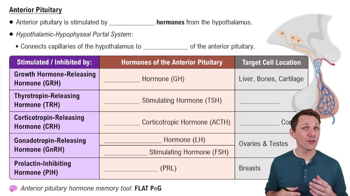
Anterior Pituitary

Liver Lobule

A liver lobule is the functional unit of the liver, typically hexagonal in shape, consisting of hepatocytes arranged around a central vein. It includes sinusoids for blood flow but is not defined by the portal triad itself, which is located at the lobule's corners.
Recommended video:
Guided course
2:59
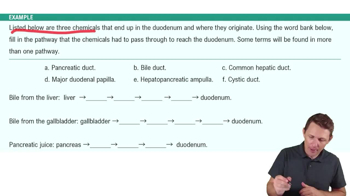
Duct System of the Liver, Gallbladder, and Pancreas Example 1

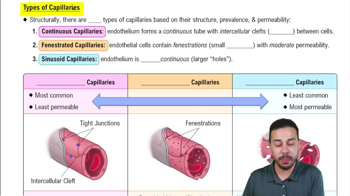
Sinusoids

Sinusoids are specialized capillaries within the liver lobules that allow blood from the hepatic artery and portal vein to mix and flow toward the central vein. They facilitate exchange between blood and liver cells but do not include bile ducts or form the portal triad.
Recommended video:
9:42
Types of Capillaries