How do pressure and resistance affect cardiac output and peripheral blood flow?
Ch. 21 Blood Vessels and Circulation

Martini, Nath, Bartholomew12th EditionFundamentals of Anatomy and PhysiologyISBN: 9780137854011Not the one you use?Change textbook
Chapter 21, Problem 21
Which of the following is greater?
(a) The osmotic pressure of the interstitial fluid during inflammation
(b) The osmotic pressure of the interstitial fluid during normal conditions
(c) Neither is greater
Verified step by step guidance1
Step 1: Understand what osmotic pressure is — it is the pressure exerted by solutes (like proteins) in a fluid that tends to draw water across a semipermeable membrane.
Step 2: Recall that under normal conditions, the interstitial fluid has a relatively low concentration of proteins, so its osmotic pressure is lower compared to plasma.
Step 3: During inflammation, the permeability of capillaries increases, allowing more proteins to leak into the interstitial fluid, which raises the protein concentration there.
Step 4: Since osmotic pressure depends on solute concentration, the increased protein content in the interstitial fluid during inflammation leads to a higher osmotic pressure compared to normal conditions.
Step 5: Therefore, compare the osmotic pressures by considering the protein concentration changes in the interstitial fluid between normal and inflamed states to determine which is greater.

Verified video answer for a similar problem:
This video solution was recommended by our tutors as helpful for the problem above.
Was this helpful?
Key Concepts
Here are the essential concepts you must grasp in order to answer the question correctly.
Osmotic Pressure
Osmotic pressure is the pressure exerted by solutes in a fluid that drives water movement across a semipermeable membrane. It depends on the concentration of solutes like proteins and ions, influencing fluid balance between compartments such as blood plasma and interstitial fluid.
Recommended video:
Guided course
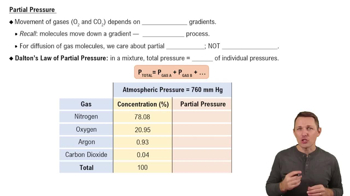
Partial Pressure
Interstitial Fluid Composition
Interstitial fluid surrounds tissue cells and normally has a lower protein concentration than plasma, resulting in lower osmotic pressure. Changes in protein content or solute concentration in this fluid can alter its osmotic pressure and affect fluid exchange.
Recommended video:
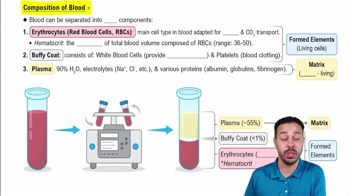
Composition of Blood
Inflammation and Vascular Permeability
During inflammation, blood vessel permeability increases, allowing proteins and immune cells to leak into the interstitial space. This raises the protein concentration and osmotic pressure of the interstitial fluid compared to normal conditions, promoting fluid accumulation and swelling.
Recommended video:
Inflammation
Related Practice
Textbook Question
2
views
Textbook Question
Which of the following conditions would have the greatest effect on peripheral resistance?
(a) Doubling the length of a vessel
(b) Doubling the diameter of a vessel
(c) Doubling the viscosity of the blood
(d) Doubling the turbulence of the blood
(e) Doubling the number of white cells in the blood
1
views
Textbook Question
How is blood pressure maintained in veins to counter the force of gravity?
1
views
Textbook Question
Why do capillaries permit the diffusion of materials, whereas arteries and veins do not?
1
views
Textbook Question
What are the primary forces that cause fluid to move?
(a) Out of a capillary at its arterial end and into the interstitial fluid
(b) Into a capillary at its venous end from the interstitial fluid?
1
views
Textbook Question
What cardiovascular changes occur at birth?
2
views